


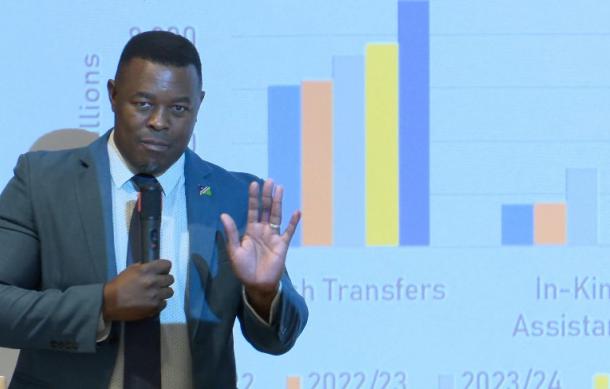
Youth unemployment, recognition of the informal sector, and persistent gender gaps are among the key challenges that the National Budget has been criticised for failing to adequately address.
These findings emerged during the analysis of the National Budget 2026/2027, which was attended by economists, Members of Parliament, union representatives, and officials from various public institutions.
Economist Mally Likukela explained that although the budget allocation is responsive to social sectors, it may not be sustainable in the long term if issues of unemployment and youth development are not adequately addressed.
"When we analyse the allocation by age group, it is evident that the majority of the funding is directed towards adults. The distribution is clearly skewed in their favour. I do not raise this as a complaint on my own behalf, nor do I deny that adults are vulnerable. However, my concern is about how we are preparing the future of this nation if most resources are concentrated on adults. The N$58 billion allocated to social spending will certainly move us forward. The figures show that the budget is responding to existing needs, and that is commendable. Nevertheless, we would like to see it respond even more effectively. These challenges must be acknowledged, and deliberate action must be taken to address them."
Executive Director of Labour Resource and Research Institute, Dr. Benediktus Ikefelwa, noted the exclusion of women in the informal sector who make up 50 percent of the informal workers.
"Women constitute about 53% of informal workers. Yet there is a significant budget gap when it comes to social protection. There are no private social protection schemes for informal workers, and no portable healthcare or pension systems designed to support them. If we fail to address these gaps, who suffers the most? Women. As policymakers and lawmakers, it is our responsibility to confront this issue and implement inclusive, gender-responsive policies that protect and empower informal workers."
Executive Director in the Ministry of Finance, Oscar Capelao highlighted some changes and improvements in the budget.
"We need to recognise that our fiscal instruments are working. We are able to mobilise more revenue domestically than others. That's also a plus. And then the other one is we highlighted the additional expenditure we are able to put onto our budget. But we still managed to get the primary parents and we also managed to bring down our overall budget deficit. So from an expenditure as a percentage of GDP, we are able to lower it to 5.5%. So to me that's also a highlight. So if we look at overall indicators, we are able to do better in our budget year compared to the current fiscal year that's coming to an end."
Organised by Friedrich Ebert Stiftung the budget analysis, looked at what extend the 2026/2027 National Budget addresses, the social inequalities in Namibia.
It further shared perspective on the social safety nets, youth unemployment, and labour gender outlook.