


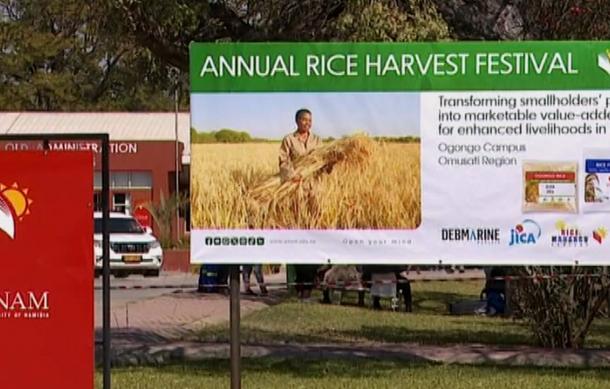
The University of Namibia's (UNAM) Ogongo Campus in the Omusati Region hosted its 14th edition of the Rice Harvesting Festival. The Ogongo Campus is recognised for its trials in rice production and its training programmes, which are designed to equip communities with the necessary skills to cultivate rice effectively.
UNAM Vice Chancellor Professor Kenneth Matengu says value addition is key to transforming rice from a staple food into a driver of economic growth and job creation.
"Through value addition, rice becomes more than a crop. It becomes a catalyst for inclusivity in economic growth. Ladies and gentlemen, today's festival will bring this vision to life, as you will see later today. There is a lot of effort that has been put in to ensure that rice is not seen as just something you eat."
Professor Matengu further highlighted UNAM's commitment to translating research into practical solutions.
The Deputy Head of Mission at the Embassy of Japan is Noriaki Sadamoto.
"This year we celebrate not just the long history of bilateral relations with Japan and Namibia but also the incredible communities that have made our impact possible. As we honour our past, we are simultaneously looking forward, using this event as a stepping stone to expand our impact on communities at the grassroots level and promote new sustainable solutions for the future of Namibia."
Sadamoto highlighted that Japan will provide research equipment worth N$2.4 million to UNAM's Neudamm campus this year and has funded a N$48 million project to boost drought resilience for farming communities.
Representative of Haven Harvest Investment CC, Sam Shilimonhulo, says guidance from UNAM's Ogongo Campus has been instrumental in expanding their rice production and improving harvest yields.
"We approached the University of Namibia, Ogongo campus, for professional guidance, and then their dedicated team introduced us to rice production and provided us with the varieties of Iriga and Supa in order for us to begin this exciting journey. Since then we have made encouraging progress: from 2024 we harvested 2.5 tonnes of rice, and in 2025 we increased our harvest to 5 tonnes, and this year we levelled up and we are now at 7 tonnes."
He further said the company's steady growth demonstrates that rice farming can be a sustainable and profitable enterprise in Namibia when supported by the right knowledge and resources. However, he noted that challenges remain, including manual planting, harvesting and threshing processes, which are labour-intensive, time-consuming and affect efficiency.
The University of Namibia's Rice Production Section at Ogongo Campus is expected to harvest more than 23 tonnes of rice in 2026.
The festival also showcased rice products such as Oluthima, rice flour, biochar, briquettes, and research done at the campus, and certificates were presented to farmers for their participation and contribution.