


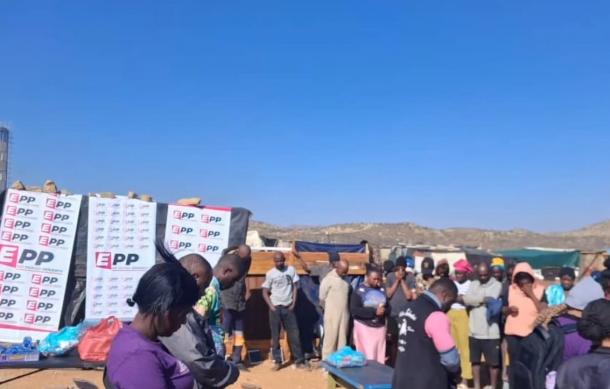
Community members of Baboon City informal settlement received training on making reusable sanitary pads and recycling household materials during an End Period Poverty (EPP) community outreach aimed at equipping families with practical skills beyond once-off donations.
The activation took place in Baboon City, an informal settlement established in 2018 by people who moved to Windhoek in search of work but were later retrenched.
Many residents continue to face poverty and limited access to basic services.
While EPP donated 15 food parcels containing maize meal, rice, cooking oil and salt to vulnerable households, organisers said the main focus was to provide sustainable solutions to menstrual health and household recycling.
Community members, including men and boys, were taught how to make reusable sanitary pads using readily available household materials.
Social activist Shaun Gariseb said involving men in the training was important to help break the stigma surrounding menstruation and encourage broader community support.
Women and girls also received fabric and instructional manuals to enable them to continue producing reusable pads at home. The pads can be used for up to a year if properly maintained by washing them with cold water.
"My name is Dankiero |Nanus, and I'm from here. This is such a great initiative, and I'm happy to be part of it. I thought it would be difficult, but it wasn't. I will also teach the others to make reusable pads."
Gariseb said the organisation deliberately chose to leave the community with practical knowledge rather than only distributing food and sanitary products, describing skills transfer as a more sustainable response to period poverty.