

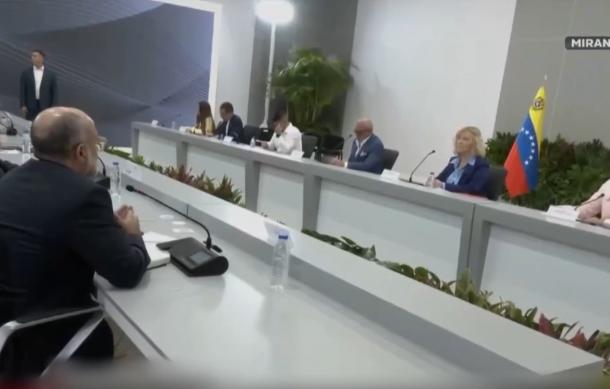
Members of Venezuela's National Assembly representing Chavismo and a sector of the Venezuelan opposition on Thursday set up a dialogue table backed by the United States in a new attempt to set a political transition on track in the country and agreed to keep talks going through August 12.
The first in-person meeting was held behind closed doors in Caracas between Jorge Rodríguez, the ruling party's chief negotiator, and Dinorah Figuera, who heads the opposition delegation made up of former deputies from the National Assembly elected in 2015.
The parties agreed on principles of good-faith negotiations, political equality, mutual respect, protection of human rights, and the pursuit of a political, peaceful, and democratic solution. The agenda includes assistance for victims of the twin earthquakes on June 24, institutional strengthening, and guarantees of political and civil rights.
Issues that could flow from the talks include the renewal of the National Electoral Council and the Supreme Court of Justice, the restoration of political rights, the lifting of bans on parties, and the setting of an electoral calendar. The opposition is also calling for the release of political prisoners and the return of exiles.
Washington backed the process and described it as an opportunity to advance its three-phase plan, which envisions stabilising Venezuela, economic recovery, political reconciliation, and an eventual transition toward democratic elections.
The initiative, however, faces questions within the opposition. María Corina Machado and Edmundo González Urrutia, the leading figures of the Democratic Unitary Platform, are not participating directly at the table, though the coalition said it expects concrete progress toward a democratic transition.