


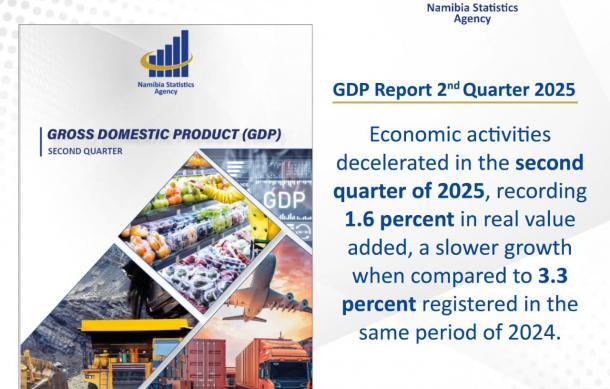
The Namibia Statistics Agency (NSA) announced on Thursday that the country’s economy grew by 1.6% in real terms during the second quarter of 2025 (Q2 2025). This represents a slowdown compared to the 3.3% increase recorded in the same period in 2024.
In nominal terms, the economy expanded to N$64.8 billion, up from N$58.8 billion in the second quarter of 2024. According to NSA Chief Statistician and Chief Executive Officer Alex Shimuafeni, growth in the second quarter of 2025 was primarily driven by the performance of tertiary industries, which recorded real value-added growth of 3.9%.
Although this was a decline from the 5.0% growth recorded in Q2 2024, the sector remained a key contributor, the NSA noted.

Key industries within the tertiary sector, including wholesale and retail trading, financial services, and public administration, posted positive growth compared to the same period last year, Shimuafeni said.
In the primary industries, real value added grew marginally by 0.1% in Q2 2025, a significant recovery from the 2.7% contraction recorded in Q2 2024. Growth was attributed to agriculture and forestry, as well as fishing and fish processing in the on-board sectors. However, both agriculture and fishing recorded declines, with agriculture contracting by 3.5% and fishing by 4.4%, owing to reduced volumes of animals marketed and lower fish landings.
Reports from the NSA further show that secondary industries experienced a notable contraction, with real value added falling by 5.8% in Q2 2025, compared to a 2% increase in Q2 2024. This downturn was largely driven by the manufacturing sector, which posted a 9.7% decline in real value added, in contrast to the 1.2% growth recorded in the same quarter of the previous year.
On the demand side, Private Final Consumption Expenditure (PFCE) fell sharply by 7.2% in Q2 2025, compared to the robust 26.6% growth seen in Q2 2024. The decline in household consumption reflected broader pressures on domestic spending. Meanwhile, Government Final Consumption Expenditure (GFCE) maintained its positive trajectory, growing by 4.2% compared to 2.6% in Q2 2024, driven by an increase in the number of public servants.
Gross Fixed Capital Formation (GFCF) showed a positive rebound, growing by 5% in the quarter, following a 0.6% decline in the corresponding period of 2024. This growth was attributed to increased investments in machinery, transportation equipment, and construction activities.