


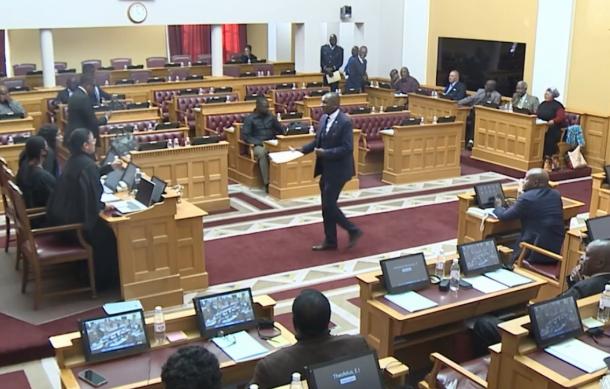
The Institute for Public Policy Research (IPPR) has emphasised the need to extend the working hours of parliament to tackle the backlog of bills.
The Executive Director Graham Hopwood of IPPR highlighted this during the institute's celebration of 25 years of insight, debate, and impact engagement held in Windhoek.
Hopwood stated that the backlog of Bills is growing and there is a need for more effective approaches to legislative processes.
Members of Parliament, he explained, need to work harder with the limited time they have to sit for a year.
He pointed to the fragmentation of opposition political parties and what appears to be division among the ruling party.
“They simply need to extend the hours and days they work to clear this backlog. Otherwise, more and more Bills will continue to pile up at the drafting stage. Even when they reach Parliament, they are not being dealt with promptly. As I mentioned, there are several examples of legislation that has remained on the books for a long time. The Mental Health Bill, which was recently passed by the National Assembly, was actually introduced 10 months ago. There are other Bills that have experienced similar delays. We appreciate that Parliament is taking the time to carefully scrutinise draft legislation, debate it, and, where necessary, refer it to committees. However, there needs to be a more effective approach to the legislative process. As I said, I believe the Speaker bears significant responsibility for ensuring progress in that regard.”
Hopwood also noted the pro-activeness of some ministers, which he says is good to see; however, he highlighted the need for proper consultations.
He referenced scenarios such as the current installation of speed humps, which has received public backlash.
“It's good to see ministers intervening, but when they act in arbitrary ways without proper consultation or careful consideration, there are unintended consequences. Politically, this is quite significant because thousands of people are affected by this window, and they are not going to be very supportive of a government that acts in this way. Another minister who has taken a very interventionist approach is Minister James Sankwasa on local government issues. Clearly, local and regional government in Namibia has been dysfunctional for some time. What he is doing is attempting to address a long-standing problem, but he is doing so in a hurry. Some of the measures he is taking may well be justified, and I am keeping an open mind about them at the moment. However, my concern is that, in practice, he is disempowering many local councils by simply charging in without adequate consultation. That creates policy uncertainty.”
Economic challenges, including policy uncertainty, job creation targets, and fiscal constraints, also centred the discussion.
“And the requirements that governments are now talking about, like a beneficiation policy, will actually place requirements on investors to do value-added activities, to do processing in the country, and to create jobs. It's not really clear how that will work because value addition has been like a slogan we've had for 10 or 15 years now, but we don't see much actual strategy. So if government comes up with a strategy that can work, we could make progress. But at the moment, there are not many prospects under this scenario that that will work out.”
The need for the Head of State to have a press conference and engage the local media was further highlighted.