


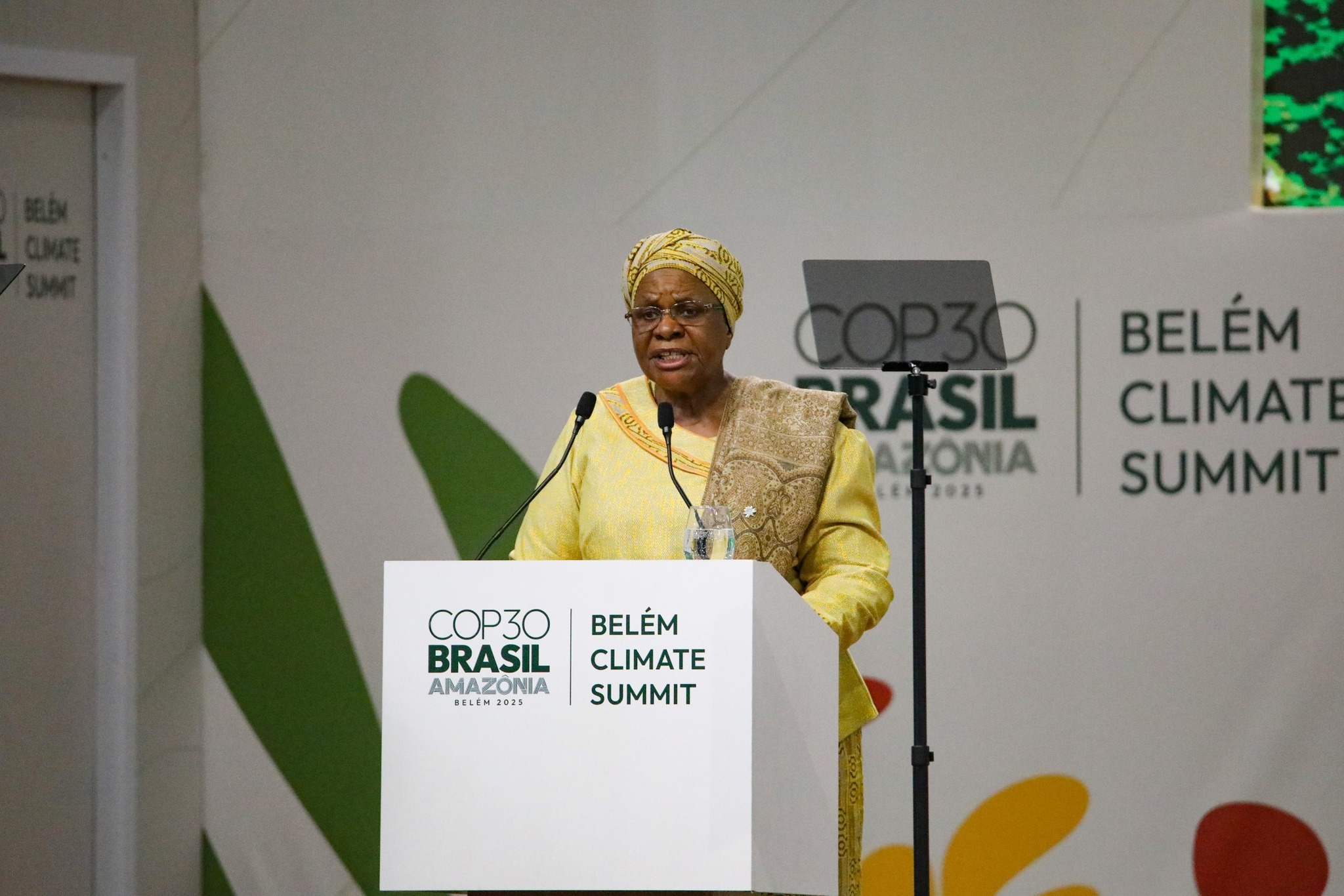
President Netumbo Nandi-Ndaitwah has issued an urgent appeal for global climate action, exposing the harsh realities confronting Namibia and calling on the world to move beyond diplomacy toward concrete results.
Delivering her address at the Belém Climate Summit in Brazil, Nandi-Ndaitwah noted that over the past 3 decades, national mean temperatures have increased by more than twice the global average.
President Nandi-Ndaitwah warned that more than 80% of Namibia's landmass is classified as arid or semi-arid, while over 70% of the population depends directly on agriculture for food security and their livelihood.
She noted that these characteristics make Namibia one of the world's most climate-vulnerable nations and underline the urgency of tackling desertification, land degradation and drought as core parts of the climate agenda.
Namibia, the head of state says, now remains a net carbon sink - the term for a system that removes more carbon dioxide from the atmosphere than it releases - with land-sector removals up 45% since 1990.
President Nandi-Ndaitwah clarified that national action alone is not sufficient.
Namibia estimates that adaptation in eight key sectors, including agriculture, water, biodiversity, fisheries, health and infrastructure, will require $6 billion, with mitigation across sectors adding up to $9 billion - of which only some 10% is expected from domestic resources.
Thus she says key national commitments include strengthening integrated water-resource management and groundwater recharge and safeguarding the supply of clean water to households, agriculture and industry.
It also includes the expansion of drought-resilient agriculture and climate-smart irrigation, promoting conservation agriculture and
the use of drought-tolerant crop varieties to protect rural incomes and national food security.
She called on developed countries, multilateral banks and private investors to provide predictable, sustainable and accessible finance at affordable cost, to support technology transfer and to strengthen national and community capacities through grants and highly concessional finance.
Crucially, she urged that COP30 must operationalise the New Collective Quantified Goal on Climate Finance of $1.3 trillion and that trade practices must be fair, while the cost of borrowing should reflect the real risks.