


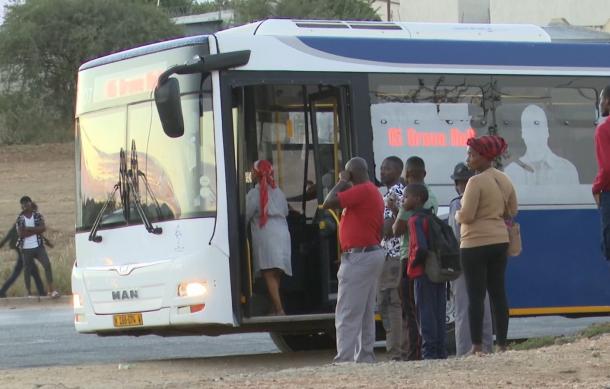
For hundreds of workers living in Windhoek's informal settlements, the workday begins long before sunrise. Many wake up as early as four o'clock in the morning to secure transport from local bus terminals to their places of employment.
Business Today producer Hendrina Kanyolo joined the working class early in the morning to find out how accessible and reliable public transport is for the workers as they commute to jobs largely located in the Central Business District and surrounding suburbs.
The Business Today team visited key loading terminals in Okuryangava and Greenwell Matongo to assess the efficiency and availability of commuter transport services.
Hundreds of Windhoek residents begin their daily commute before dawn, gathering at bus terminals in search of affordable transport to work.
There is a high demand for limited transport services, with commuters competing for seats on available minibuses and municipal buses during the early morning rush.
Workers say the shortage of municipal buses remains a major challenge, resulting in congestion and long waiting times. Some commuters say despite arriving as early as 4AM, securing transport can still take several hours due to the high demand.
"We are suffering, as you can see. I am carrying a chair, and I am on my way to work. I came here around five this morning. However, there are no taxis, I mean any buses. I am on my way to Klein Windhoek, but there are no buses at all. The men are squeezing and pushing to get in the buses. I ended up falling and broke my chair. I will continue struggling so that I can get a lift," bemoaned city commuter Bertha Singulesi.
Regular users of the municipal bus system are now calling on the municipality to expand access to bus payment cards.
Currently, the cards can only be purchased at the City of Windhoek offices, a process commuters say is inconvenient for workers who have limited time during working hours. With the municipality buses, you can only go with them if you own a card, but like some of us, we cannot afford to make the cards because we don't make much. It was better when we could pay with cash.
Another city commuter, Lennete Paulus, adds, "Every morning I walk from Goreangab Dam up to here. Then it is the same situation with the buses like you are observing now. We start at 08H00; you end up getting to work at 09H00, and then you get in trouble with your employer. Here we are getting stepped on and ending up dying. Look, look at that situation over there. We are being killed and stepped on, but we continue standing and making sure we get lifts to get to work. We don't use the municipal buses because they do not go to Triple J. The buses that come here all go to Cimbebasia. The only buses we find are these small ones that cost N$13.00."
Commuters argue that making the cards available at retail outlets such as shops and service stations would significantly improve accessibility and efficiency for daily passengers.