


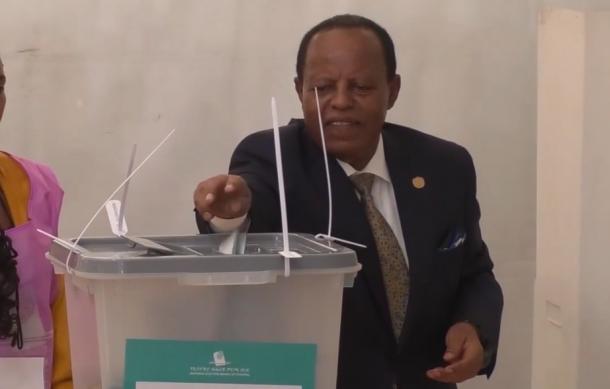
Ethiopian President Taye Atske-Selassie on Monday cast his ballot in the country’s seventh national general election, telling supporters outside, "The ballot is stronger than the bullet," amid ongoing political tensions and security challenges.
Footage from the capital showed voters queuing early outside polling stations, with long lines forming before the president arrived to cast his vote.
“I’m very much excited. I know there are so many detractors out there. There's nothing new about it. It has been the case all over the world,” Taye said after voting in Addis Ababa.
“But indeed, this is a day that we show to the world that the ballot is stronger than the bullet. So I'm just voting for my community, voting for myself, and voting for my family. It's a very special day,” he added.
According to the National Election Board of Ethiopia (NEBE), more than 50 million people registered to vote, out of a population of around 130 million. Voters will elect 500 members of the House of People's Representatives, as well as representatives to regional and city councils.
While the number of registered voters is nearly a third higher than in the 2021 election, NEBE has excluded 46 of the 176 total constituencies across the country from Monday's vote due to active warfare and insurgencies. This includes all 38 constituencies in the Tigray Region, eight in Amhara, as well as localised disruptions in Oromia.
Under Ethiopia's parliamentary system, the party that wins a majority in the legislature will choose the country's next prime minister.
Incumbent Prime Minister Abiy Ahmed has led Ethiopia for the past eight years. He heads the Prosperity Party, which has governed the country since its formation in 2019. The party succeeded the former ruling coalition, the Ethiopian People's Revolutionary Democratic Front (EPRDF), which held power from 1991 to 2018.