


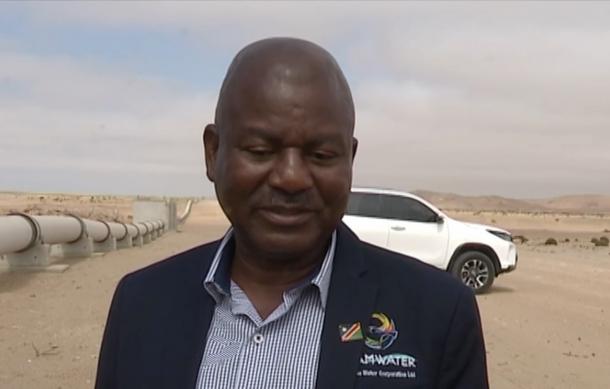
NamWater is driving negotiations to establish local manufacturing of large-diameter water pipes, reducing reliance on imports from China and Europe.
The Namibian government and the German Development Bank are spending close to N$84 million to upgrade a nine-kilometre water pipeline near Swakopmund and Walvis Bay.
NamWater's Chief Executive Officer, Abraham Nehemia, says most of that money is spent on importing materials needed to construct the pipeline because they are not manufactured locally.
"NamWater is currently engaging various partners to look at the possibility of putting up a manufacturing plant in Namibia. We are at an advanced stage with that. We are going to see how we are going to ensure that it kicks off the ground as soon as possible."
Nehemia reveals that imports increase project costs, slow construction and drive up water tariffs.
He says the proposed factory, which would be set up in the Erongo Region, could also serve regional markets, including Angola and Zambia.
"We know NamWater is there to build the pipelines and not to get into manufacturing, but definitely we have to drive this, because for us that is a major component that's going to help us to accelerate the development, accelerate infrastructure development in the country. And we have a number of projects that are lining up that will definitely need pipes."
The Erongo Governor Natalia |Goagoses urged the state-owned enterprise to additionally ensure that locals participate in the design and construction of major water infrastructure projects, like the upgrade of the pipeline near Swakopmund.
"Let the mechanical and civic engineers in Namibia come to this project, come and volunteer, so that you know how practically we can build these pipes in Namibia. Because for too long, I have been observing that we are not benefiting from the skills that we are getting from our friendly friends, like Chinese and Germany."
The NamWater chief engineer Saltiel Shaanika revealed that the company's engineers, who are Namibians, were responsible for designing the project internally.
"So when we are able to design in-house, we're cutting the cost, and that way we actually enable the overall cost of the project to get a bit lower. And that also eventually reflects on the tariff. So the lower the capital cost, eventually the lower the tariff that is associated with the infrastructure that we have actually built."
The proposed manufacturing plant is expected to support future infrastructure projects and strengthen Namibia's capacity to produce critical water infrastructure locally.