


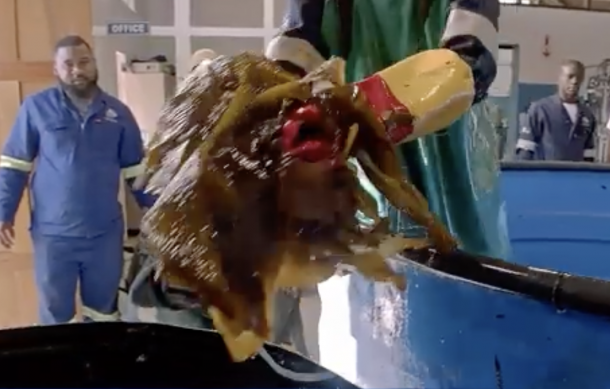
Scientists have raised questions regarding some of the environmental claims surrounding Kelp Blue's giant kelp cultivation project off Lüderitz.
They claim that the presence of marine species around the farm alone does not prove population recovery.
Kelp Blue is cultivating giant kelp, known as Macrocystis pyrifera, off the coast of Lüderitz as part of a large-scale marine cultivation project.
The company believes that the cultivated structures are creating habitat for marine life, with various fish and other species being observed around the farm.
But a recent scientific commentary by researchers from the University of the Western Cape and the University of Galway questioned whether these observations are enough to demonstrate ecological recovery.
The researchers argued that finding fish around the structures does not necessarily prove that the kelp is providing shelter, supporting breeding, or contributing to the recovery of fish populations.
Kelp Blue's Kelp Operations Leader, Protasius Mutjida, stated that the company has been monitoring the area since before the farm was established.
“We started first developing what we call a baseline. In that baseline study, we have seen what was there before the farm was set up. Over the years, we have done different monitoring approaches to be able to identify the different species at sea.”
He said the monitoring includes environmental DNA, underwater surveys, and sensors used to identify marine species.
Kelp Blue also pointed to research examining how marine animals are using the cultivated kelp structures.
One recent study involving Kelp Blue and the University of Namibia compared West Coast rock lobster populations in cultivated and natural kelp habitats near Lüderitz.
It found higher lobster abundance in the cultivated kelp area, with smaller lobsters more common there. The researchers concluded the cultivated site may function as a nursery habitat, while the natural kelp site supports larger lobsters.
“The kelp farm that we are growing showed that most of these juvenile or younger crayfish are getting attracted to the structures where we are buoying.”
The scientists have also raised concerns about the introduction of giant kelp to Lüderitz and the potential ecological risks associated with its spread.
Kelp Blue said environmental monitoring is being conducted beyond the farm to identify possible changes along the coastline.
Kelp Blue's environmental assessment also identifies the possibility of Macrocystis established in suitable sheltered areas and sets out monitoring and mitigation considerations.
Mutjida also emphasised that the company remains open to scrutiny and collaboration as the project develops.
The researchers, meanwhile, called for evidence that can independently demonstrate both the ecological benefits and potential risks of the project.