


Universal access does not mean that every school must receive exactly the same infrastructure but that every child should receive an equivalent standard of safe, reliable and dignified service.
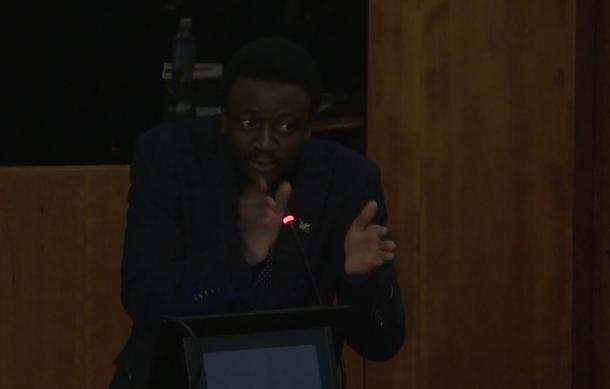
Sustainable Development Advocate and Youth Climate Negotiator Deon Shekuza said this during a presentation in the Junior National Council, stressing that water, sanitation and hygiene services should not be viewed solely as physical infrastructure.
Shekuza stressed that a drought-prone school may require a different solution from a school that is vulnerable to flooding; thus, he urged MPs, when debating universality, to remember that it is fundamentally about equity, dignity and standards, rather than identical technology.
"I'm asking you to place the child at the centre of the entire water infrastructure in Namibia so that it would make it much easier for you to actually debate for positions that are related and relatable to the child. Because if we're going to the statistics, you'd realise, for example, that Namibia is doing very well on water access. You've heard that we've got over 90% water access ability. From the Ministry of Education perspective, we are looking at 95.3% of schools that have a water supply. That should be sitting around the region of 2,000-plus schools. However, a more important question when it comes to Wash then means is who uses that and how applicable is that, and how friendly is that to the child?"
He pointed out that 89.8% of schools have learner toilets, which means around 205 schools still lack sanitation facilities.
Shekuza also talked about how droughts, floods and extreme heat are affecting Water, Sanitation and Hygiene (WASH) infrastructure. He said schools need to be built and maintained to handle climate challenges.
He called on the Junior National Council to include maintenance, water storage, sanitation, hygiene, accessibility for children with disabilities and menstrual health facilities in their discussions.
"It can be very costly. So you want to maybe say we must improve on maintenance if the technology is available. But how we arrived at that would not require you to be a bit more deliberate in your assumptions, and I started this with a disclaimer: I told you you put the child at the centre of the entire infrastructure. That basically means the child becomes a unit of measurement because currently we don't use the child as a measurement."