


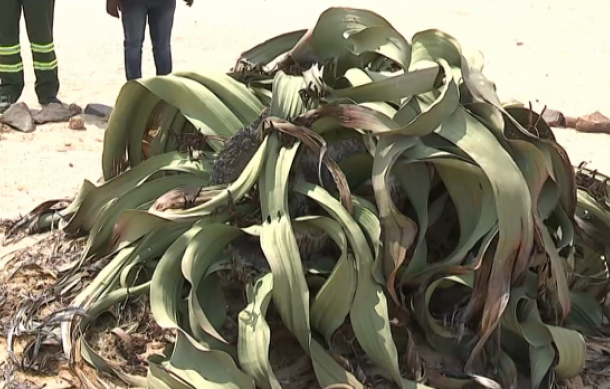
Swakop Uranium is implementing a project to protect Namibia's iconic Welwitschia plant through scientific research, monitoring and conservation initiatives.
The Welwitschia is one of Namibia's most distinctive plants, surviving for centuries in one of the world's harshest environments.
At Swakop Uranium's Husab mine, conservation efforts are going beyond simply protecting existing plants.
A young local scientist, Dr. Ndamonenghenda Hamunyela, who grew up in northern Namibia and studied at the University of Namibia and institutions in South Africa, is part of a research project aimed at improving scientific understanding of the species.
"The reason why we are doing this research is because the understanding surrounding the survival of Welwitschia is very low. So that's why we need to improve it.
So there are a lot of speculations surrounding how they get the water, but when they are small, fog, definitely they get the water from the fog, not through their leaves, though, through this fibrous root system that they have. And then they grow this very long tap root that goes and reaches the underground water. Yeah.
But that is a science that we need to continuously improve and understand, because for conservation purposes you need to make informed decisions. And that's why Swakop Uranium Now is working very hard to ensure that we understand how Welwitschia survive here, how the population is, and the genetic diversity."
Swakop Uranium has also begun exploring the use of drones and remote sensing to monitor Welwitschia populations more efficiently than traditional foot surveys.
"Now we are trying to incorporate remote sensing with drone surveys. And we have started already.
And part of this project is also funding part of this Welwitschia project that we have rolled out. To just test the methodology to see the feasibility of using drone mapping."
The NBC Director General, Menesia Muinjo, who visited the iconic plant with her senior leadership team, said the research represents both environmental responsibility and the development of Namibian scientific expertise.
"Brilliant, inspiring story. When you see a young Namibian academically qualified at that level. Apart from being a professional. You get so inspired. Namibians are actually telling their own stories. And that is what we want when we talk about human development in Namibia."
Muinjo says Dr. Hamunyela's work demonstrates what young Namibians can achieve through academic advancement, while Swakop Uranium maintains that protecting biodiversity remains part of its broader environmental stewardship.