


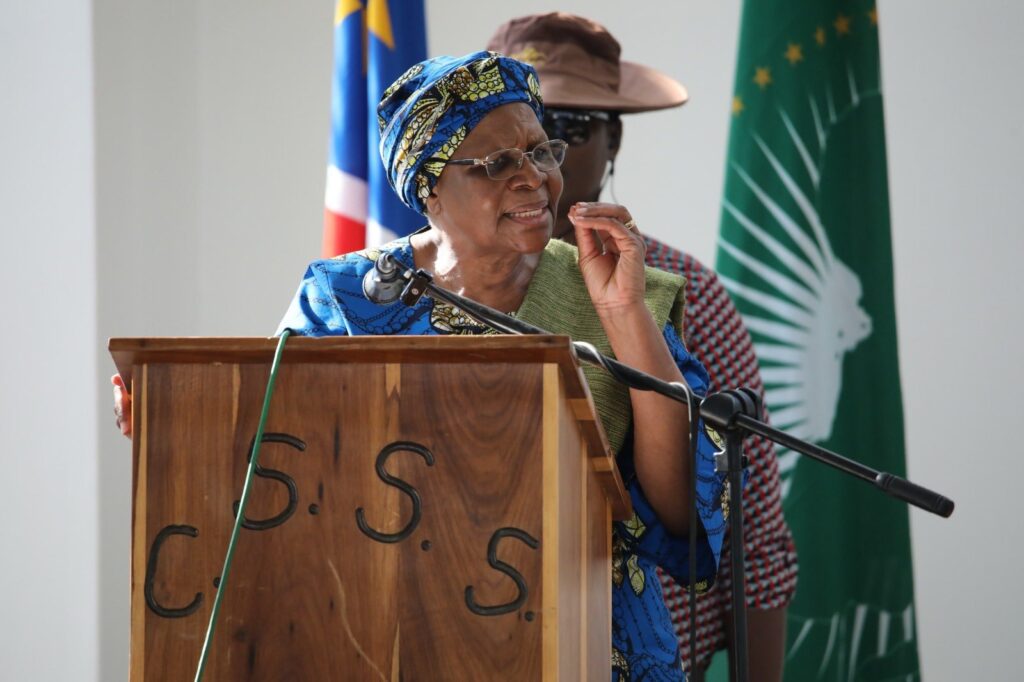
President Netumbo Nandi-Ndaitwah has emphasised that agriculture remains the number-one priority for her government; hence, it's taking the lead in ensuring that green schemes in the country are working properly and contributing to food security.
The president visited the Etunda Green Schemes Irrigation project in the Omusati Region.
Her first stop was at Otjimbele Agriculture, where she witnessed the trial of 15 hectares of grapes under irrigation.
The grape project at Otjimbele Agriculture started in 2023, and the grapes currently in the field will be their second harvest.
Nine grape varieties of Spanish origin are planted, while five different varieties from California are planned to be brought to the project soon.
They employ more than a hundred people.
The president was briefed on the status of the projects at the green scheme by Ivor Powell, General Manager at Otjimbele Agriculture.
"By December, we hope to have another 22 hectares planted as well. We want to expand the project to be like Ausenker; you know, they are doing so well with grapes for the Namibian people, so that is the dream – to be like them."
President Nandi-Ndaitwah said these projects were created to contribute to food security, as a nation that cannot feed itself will not be respected.
"Agriculture is the key, and our government is committed to working with you. We are just asking each one of us to play our part. It is not that we are not concentrating on others; we are, but this is the cow that we can milk easily."
President Nandi-Ndaitwah was then taken to an asparagus plantation, harvesting 232 hectares of maize commercially as well as 22 hectares of potatoes under irrigation.
These are expected to be harvested in October, said Sacky Shilyomunhu, manager of the Etunda Irrigation Project.
"We have also planted 6 hectares of watermelons that will be ready in November. The project has also started planting 270 hectares of early summer maize that will be ready in March 2026."
Etunda faced the challenge of high water and electricity utilities that threaten the project's sustainability and productivity.
Inadequate machinery also hinders planting and harvesting, and further delays planting cycles.
Continued vandalism of the fence by members of the community who aim to gain entry to the project is another concern.