


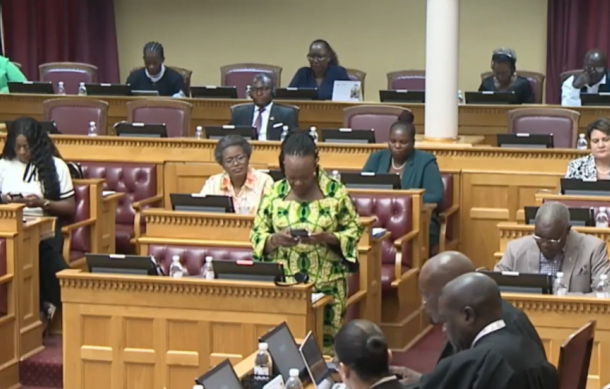
Minister of International Relations and Cooperation Selma Ashipala-Musavyi briefed Parliament on the political unrest in Madagascar, where the military has taken control following the impeachment of President Andry Rajoelina.
She said SADC and the African Union are monitoring the situation and working to restore constitutional order.
She stated that the African Union Peace and Security Council convened an emergency session to discuss the deteriorating situation in Madagascar, where they reiterated the AU's zero tolerance of unconstitutional changes of government.
"The Peace and Security Council also expressed this concern over the unfolding developments, and the Peace and Security Council stressed that they totally reject any attempt at an unconstitutional change of government. The President of Namibia affirms that Namibia remains firmly committed to constitutional governance and the rule of law. We do not support unconstitutional change of government, regardless of the circumstances. We call upon all actors in Madagascar to prioritise dialogue."
Ashipala-Musavyi added that there are no Namibian nationals in Madagascar and that the situation remains fluid and unpredictable.
Turning to Palestine, the minister said Namibia maintains its support for a two-state solution and called on the international community to renew efforts toward lasting peace.
She said Namibia's foreign policy is rooted in respect for democracy, sovereignty and good governance.
MPs raised several questions following the statement. PDM Leader McHenry Venaani asked, "If there has been a military coup, SADC rules are clear: the country must be suspended. Why is SADC not taking that decision on Madagascar?"
IPC MP Immanuel Nashinge also added his voice to the discussion, questioning, "How do we plan to move into the future to address issues of contradictions? And when we are faced by situations like this, in Madagascar, the ousted president took over through a coup. We condemned it. I believe that I was still a bit young, and then we said, 'You are one of us.' Now we are condemning this one, and next week, when all is done, we will be friends. What are the plans for us to manage these things so that we don't just make our commitment sound like just rhetoric but truly mean it in terms of us being able to maintain and protect the very democracy that we have?"
In her response, Ashipala-Musavyi clarified that SADC follows a process of sending a fact-finding mission before any decision on suspension is made.
She said the SADC Organ's current consultations involve Malawi, South Africa, and Eswatini, pending the outcome of the mission in Madagascar.