


Komsberg Farm, trading as Socotra Island Investment (PTY), aims to secure a significant share of the international market share as a leading fruit exporter.
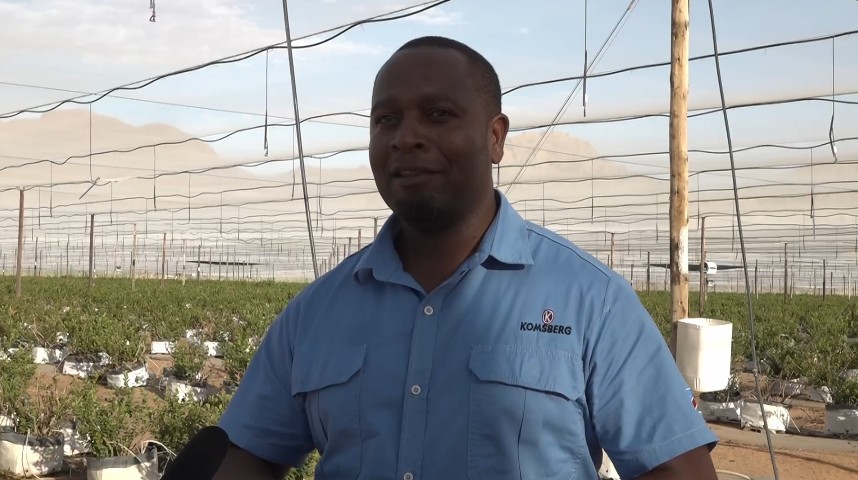
Its production manager, Arlington Chinhengo, shared the ambition in an interview with NBC News.
Located along the Orange River near the Ariamsvlei border post in ||Kharas Region, Komsberg farm spans 23 000 hectares and cultivates grapes, blueberries, dates and oranges for the international export market.
Arlington Chinhengo is the production manager at Komsberg Farm.
"Just from last season, we did at least more than 110 tonnes of blueberries. That's not a small number, and it's always meant for export. And we are currently exporting to the Middle East, Europe and a bit to South Africa for all our crops. Then we also did grapes; we did very well. We were almost at 300 000 kg, which is also good. And citrus was just above 500 kg. So in terms of Komsberg's impact on ||Kharas as a region, we have a strong impact there. Remember, Komsberg is actually one of the biggest fruit exporters in Namibia. So we are very proud of it. We farm with pride. And as I said over the years, over the years I think our five-year plan is to put Komsberg on the map. Yes, it's there, but everywhere you go, Komsberg must be a known name."
The production manager highlighted cumbersome, time-consuming processes to import chemicals and fertilisers as a key challenge.
"The permit process and the whole processing, in fact, are taking too long; it takes a month for me if I order today to get the same chemical on the farm. Then the other area is that there are certain chemicals that are registered for agriculture. Mostly because, for example, sulphuric acid is one of the key elements for blueberries but is not registered for agriculture but for mining. So, those are some of the key things that we are pushing with the Ministry of Agriculture so that we sit down and discuss and impart the knowledge so that they know what we need and what we have to produce."
The farm also boasts a modern state-of-the-art irrigation system.
"Everything is now automated. So, it makes our work easy. Everything is monitored. So, we are using monitoring props. So. We know what is happening. So, we don't over-irrigate or under-irrigate."
The farms employ more than 30 workers and more than 1 500 seasonal workers.