


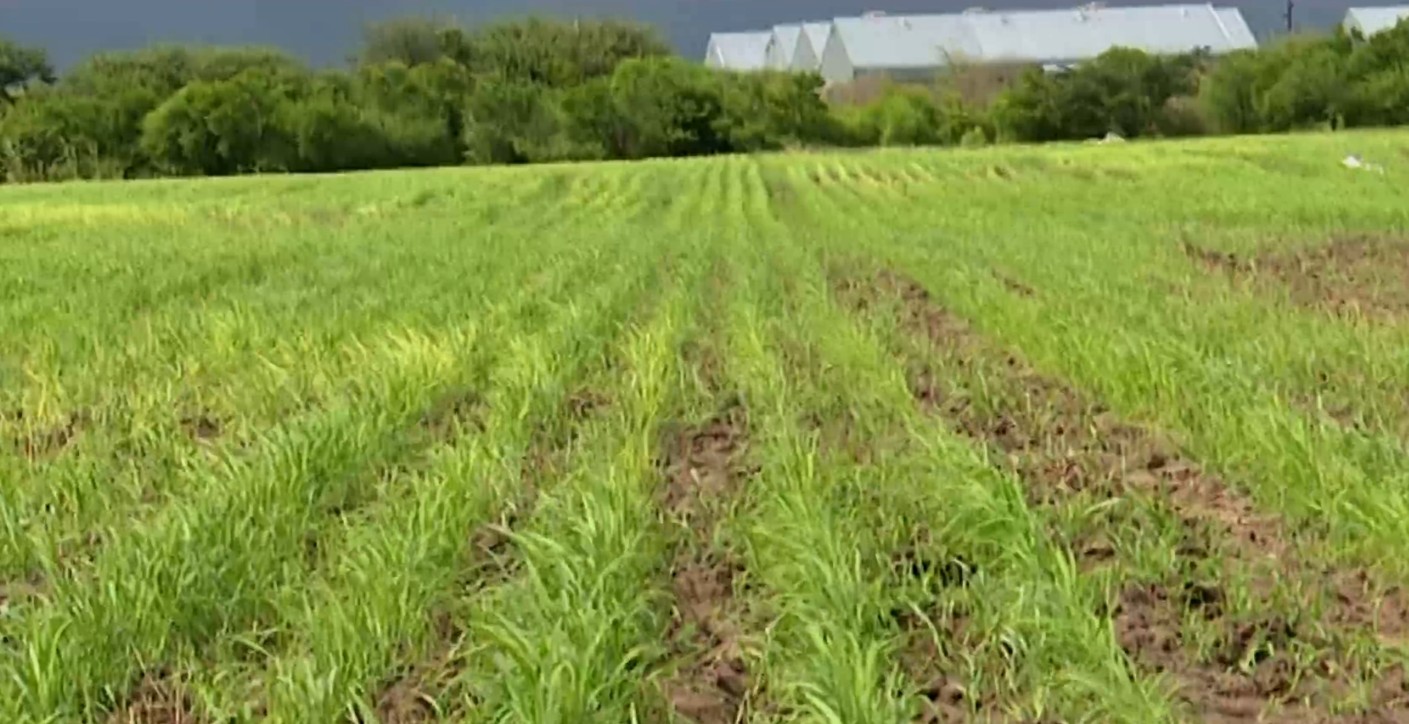
The Sikondo Green Scheme in Kavango West has planted five hectares of rice as an experiment.
If successful, the green scheme would be the first in the country to plant rice under center pivot irrigation.
Acting Farm Manager Maxwell Nghidinwa explained that they are going to replicate the experiment a couple of times, allowing them to collect sufficient data for evidence-based decisions.
The trial started in early January. This comes after a group of local green scheme managers travelled to China.
“This trip was very enlightening because we visited various production centers and research centers, and at one of them, what was very interesting was we asked in China whether they have varieties you can grow without using a flooded irrigation system. Astonishingly, they actually said rice can actually grow without a flooding irrigation system. The reason why Chinese use the flooding irrigation system is basically to reduce the cost of weeding.”
As a crop, rice is a grass, so it's tolerant to a lot of water. The flooding system therefore just suppresses the weeds.
“That for me was mind-blowing because the narrative has always been that floods grow rice. So the next step was then to consult my counterpart, Mr. Kompeli, at Kalimbeza, and we started discussing the possibility for Sikondo to do a trial under center pivot. At first it was difficult because we didn't have any access to seeds within the country, and then, thanks to Mr. Kompeli, he was able to procure for us about five 50 kg bags from Zambia.”
Namibians eat a lot of rice, Ngindinwa noted, so planting it locally is a good business opportunity.
“Rice is not a crop controlled by the Namibia Agronomic Board (NAB) who is currently controls only wheat and maize. This can create an opportunity for us to recover our costs by setting a price that is not only profitable for us but also helps the farm generate some very good income. The other aspect is just to reduce the prices. As a commercial farm, if you have to grow rice on large areas, the farm gate price will be significantly lower than the price per kilogramme we buy in the shops.”
The acting farm manager highlighted that green schemes are not necessarily meant to do research since they are a production unit.
He, however, emphasised that there is a gap that exists, adding that not all universities and research stations are doing the necessary work to advance food security in the country.
Nghidinwa added that Sikondo is therefore just contributing by allocating a few resources to help in collecting data.
The green scheme is experimenting with the Irga variety.