


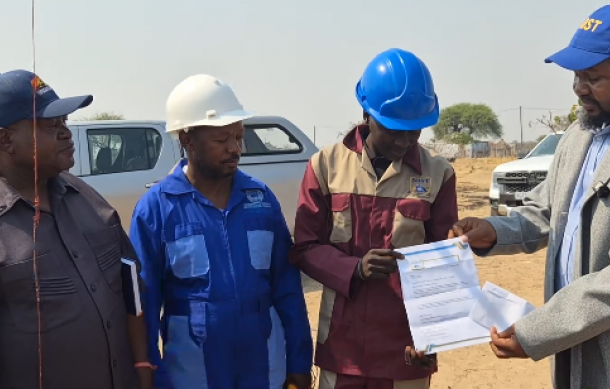
The 19-year-old self-taught innovator from the Gcwagi village in the Kavango West Region, Visentius Kapumburu, has been offered an opportunity to further his studies at the Rundu-based Ngato Institute of Science and Technology.
The three-year fully funded scholarship started in September.
A board member of the institute, Lawrence Ortman, gave an overview of the programme.
“The programme is Solar Equipment Installation and Maintenance. There are two electrical engineering courses: Electrical General and Solar. For Kakumbure, it is solar equipment installation and maintenance. As you can see, that is what is happening here. The study level, is Level One, and then you progress to the later levels. As I mentioned earlier, the scholarship is a full scholarship covering accommodation, meals, tuition, materials, and books.”
Kapumburu's talent was uncovered by officials from the Ministry of Information and Communication Technology in Kavango West, who sought support on his behalf.
The power Kapumburu generates now is still low, but the concept can be developed and replicated to benefit more households.
Director of Ngato Institute of Science and Technology Fernando Kaushiwetu explained.
“Safety comes first. It’s not 100% safe, but the current voltage it is receiving is direct current, which is only 0.7 to 0.9 volts. The highest is 0.9 volts. However, it is said to generate more power during the night. That’s why I say we need to conduct further studies to understand how it generates more power and up to what voltage. Currently, it is safe for the people in the house. I think it is commendable as a self-charging light. It is not regulated because it does not store electricity; it only generates and uses it. But where we are going now, we are looking at how we can store the electricity and also control the amount of electricity being generated.”
Kapumburu's story is proof that innovation can start anywhere, even in a village with no power line.