


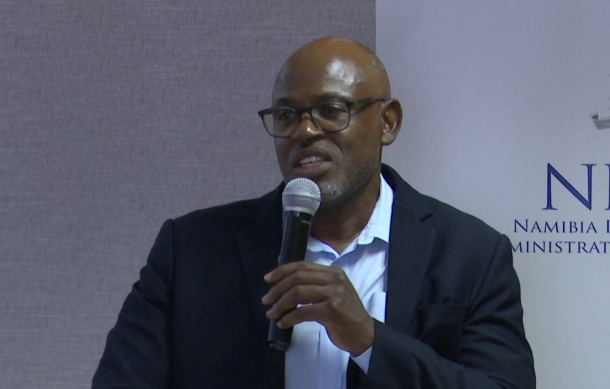
The Executive Director of the Namibia Institute of Public Administration and Management-NIPAM has expressed concern over government ministries and entities that exploit the institution by sending staff for training and refusing to pay.
Dr. Heroldt Murangi said this was at the opening of a training for Learning Development Officers and Human Resource Managers.
Dr. Murangi raised concerns over outstanding debts owed to the institution by various government institutions for employee training.
"You send your people here without any purchase order. After we have trained them, you are refusing to pay NIPAM. Last Friday we had a session at the office of the Prime Minister just to present our budget for the mid-table review. My last slide was about the money that you owe us as ministries. The Minister of Finance made it a point that this week we should send the list to her office for the non-payment. I think NIPAM is here to support you, and we will be able to review our programmes. We will be able to develop new programmes if we are supported by you financially. You are receiving money from the government for training. That money should be used for training. You cannot just send people for training without any commitment."
He also highlighted challenges such as institutions failing to verify and confirm the number of employees requiring training, as well as delays in responding to NIPAM.
NIPAM's Finance Manager, Vernon van Wyk, confirmed that the exact amount of unpaid bills sits at N$10,95 million.
"The payment is delayed, and the debt rate is unnecessary. If I go back to this slide, from this, N$10.9 million, maybe
N$6 or N$7 million relates to the prior year, 10 invoices that are not being settled. But what does that now mean? All the ministries almost must go back to the treasury and request all this funding because this wasn't a budget for your current financial rate. Then the process is deemed delayed again. And we keep on going."
He says 63% of the debt is from ministries and government enterprises, while the majority is linked to other institutions.
Van Wyk says delays in procurement processes, particularly the issuing of purchase orders, make it difficult for NIPAM to receive funds needed to cover operational costs such as electricity, venue hire and training materials, which are essential for delivering quality services.