


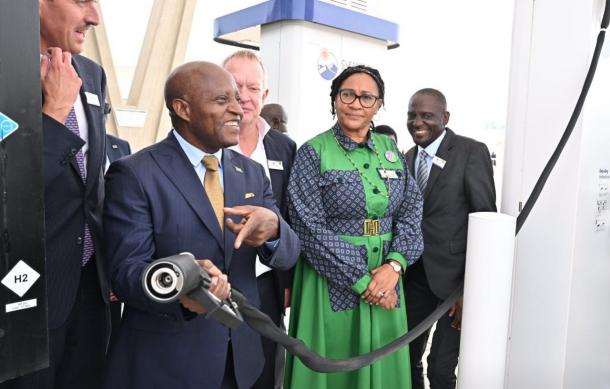
Namibia has officially launched its first large-scale green hydrogen project at Walvis Bay, Erongo Region, positioning the country as a pioneer in Africa's clean energy revolution.
The event was witnessed by national leaders, European dignitaries, industry stakeholders, and the community to celebrate a major milestone in Namibia's clean energy journey.
Prime Minister Elijah Ngurare, speaking on behalf of President Netumbo Nandi-Ndaitwah, described the event as a historic milestone that will transform Namibia's economy and create new opportunities for citizens.
The project is a joint venture between Namibia's Ohlthaver & List and Belgium's CMB. TECH, with backing from the European Union and the German government.
The site features a solar-powered, off-grid electrolyser producing green hydrogen, a refuelling station for hydrogen-powered vehicles and industrial applications, and a Hydrogen Academy to train Namibians in hydrogen technologies.
The government says the hydrogen Dune project speaks directly to the objectives of the Sixth National Development Plan and Vision 2030, with a focus on inclusive growth, sustainability, industrialisation, and social upliftment.
"O&L, as Namibia's largest privately owned company, continues to demonstrate its deep commitment to our nation's development, while CMB.TECH's investment underscores international confidence in Namibia as a frontier of clean energy innovation. Equally, I extend my sincere gratitude to the Government of the Federal Republic of Germany for its steadfast support. This partnership illustrates that Namibia is not alone – we are part of a global coalition committed to building a sustainable future."
Florian Seitz from Germany's Ministry of Research and Technology also spoke at the event. "Ladies and gentlemen, as part of my job, I travel around the world and promote our projects under the global investment strategy, and I am happy that operations with Namibia are an example of a strong strategic partnership that I use very often."
EU Commissioner Jozef Sikela said the initiative proves that international partnerships can deliver results, creating jobs, training young Namibians, and supporting small businesses.
The EU has already committed over N$25 billion in grants and loans, unlocking billions more in potential private investment for Namibia's hydrogen industry.
"German citizens' tax payments have contributed almost €50 million of public money through the construction of this plant into related research and activities, and that's more than a third of the money spent so far in this context. I am proud to announce that yesterday our German government approved the further increase of funding of over €2 million for this future-related project."
The locally produced green hydrogen is already being used for road transport, off-road applications, and off-grid power generation.