


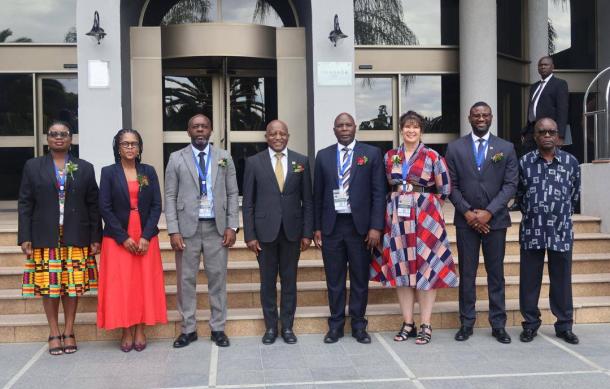
Prime Minister Elijah Ngurare said climate change, disaster risks and environmental degradation continue to test the resilience of nations, communities and ecosystems.
Dr. Ngurare said the frequency and intensity of droughts, floods and other extreme weather events have increased across Africa, threatening food security, public health and infrastructure.
Speaking at the Climate Change and Futures in Africa conference in Windhoek, the Prime Minister, Dr. Elijah Ngurare, pointed out that climate change is no longer a distant reality; it is a reality affecting livelihoods, economic systems and security. He stated that Namibia is particularly vulnerable to the effects of climate change.
Namibia suffered the worst drought in 2019, while the government declared four states of emergency over the past decade. Dr. Ngurare pointed out that given the magnitude and consequences of disasters in Namibia, disaster management is a priority for every local authority and region in Namibia.
The three-day conference is jointly organised by Namibia's National Commission on Research, Science and Technology and South Africa's Human Sciences Research Council, in collaboration with several regional and international partners.
Professor Jacob Nyambe is the Chairperson of the Board of Commissioners for the National Commission on Research, Science and Technology.
"It is through such partnerships that we strengthen Africa's research and ecosystems and enhance our collective capacity to respond to climate change in a way that is inclusive, just and sustainable."
Professor Sarah Mosoetsa, the Chief Executive Officer of the Human Sciences Research Council in South Africa, had this to say.
The conference brings together more than 100 experts and delegates from countries including Namibia, South Africa, Canada, Zimbabwe, Botswana, Kenya, and Germany.