


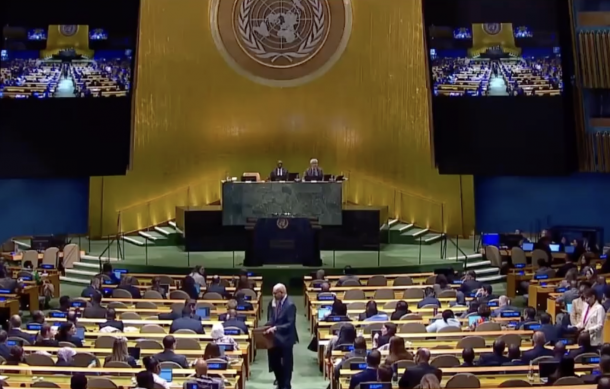
The United Nations General Assembly has passed a resolution recognising slavery as one of the gravest crimes against humanity.
This comes after Ghana’s President, John Mahama, proposed the resolution at the Assembly, seeking to declare the transatlantic slave trade as the gravest crime against humanity.
The motion urged member states to engage in inclusive, good-faith dialogue on reparations, including full formal apologies, financial compensation, measures for restitution, and the return of cultural and spiritual artefacts looted during the colonial era.
President Netumbo Nandi-Ndaitwah was among the leaders who supported the resolution recognising the transatlantic slave trade as the gravest crime against humanity.
One hundred and twenty-three countries supported the resolution, while three opposed it, including the United States and Israel. Fifty-two abstained, including the European Union and the United Kingdom.
The commemorative meeting of the General Assembly marked the International Day of Remembrance of the Victims of Slavery and the Transatlantic Slave Trade.
Namibia’s Permanent Representative to the UN, Penda Naanda, said the resolution represents an important multilateral step in advancing truth, remembrance, learning, and collective moral responsibility.
“Your Excellencies, although the international community formally committed itself over a century ago to ending the slave trade, including through decolonisation efforts and the codification of human rights, justice remains incomplete. In particular, gaps persist in legal accountability for colonial wrongs and in addressing the trans-generational social, economic, and cultural harm inflicted on our peoples, communities, and countries. This resolution, therefore, represents an important multilateral step in advancing truth.”
United Nations Secretary-General António Guterres noted that the transatlantic slave trade was a crime against humanity that struck at the core of personhood, broke up families, and devastated communities.
He further noted that, according to African Union estimates, reparations owed are significant.
“These monstrous acts were the core of a global economic and social order, a system born of greed, built on lies, and enforced by violence. A system that prevailed for over 400 years and haunts our world even now—a system that reflected the worst of humanity. And that is why today is more than a time of remembrance. It is a moment to confront the lasting legacies of inequality and racism. We will never forget the victims of slavery, and we must never forget the malevolent system that sustained it for so long.”
The United States Representative to the UN, Dan Negrea, said that while the US acknowledges the horrors of the past, it does not accept the resolution’s assertion.
“The United States also does not recognise a legal right to reparations for historical wrongs that were not illegal under international law at the time they occurred. The United States strongly objects to the cynical use of historical wrongs as leverage in an attempt to reallocate modern resources to people and nations who are only distantly related to the historical victims.”