


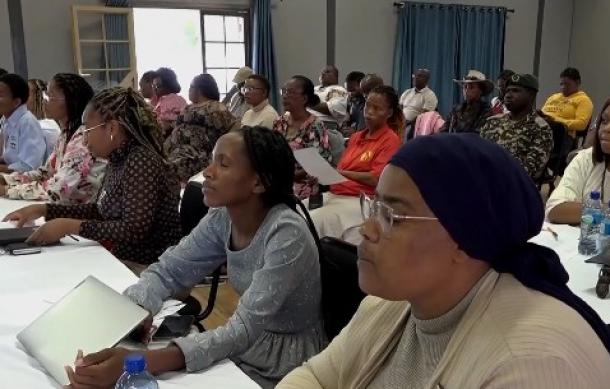
The Omaheke Regional Council hosted a Regional Gender Task Force meeting in Gobabis, bringing together different stakeholders to discuss challenges affecting communities in the region.
The meeting, organised by the Division of Gender Equality, Poverty Eradication and Social Welfare, focused on sharing information and finding ways to work together.
The Regional Gender Task Force is a body within the region that helps oversee and sensitise the implementation of gender programmes.
The Chief Community Liaison Officer of MGEPESW, Therencia Tjaondo, had this to say:
"This is a combination of different stakeholders; all stakeholders play their roles in terms of how they contribute and how they try to combat the plight against GBV. What we are doing in this essence is an activity that we are supposed to be conducting once annually. As compared with the constituency taskforce, we are gathered in Gobabis to have a report in terms of how all these problems can be written down for reference in case we have to share what our problems are at a national level."
The task force plays an important role in supporting learners beyond the classroom, especially when it comes to their well-being, and through collaboration with different stakeholders, it ensures that children receive the support they need.
"If effectively implemented, it means a lot for the children; it deals with the psychosocial part of the learner. We get to refer the kids for counselling, and after counselling it is a whole process; we also include the parents. Sometimes you find out that homes are broken, and then at the end of the day after all these processes you find that while bringing in all the other ministries, we actually find lasting solutions. It helps a lot of learners; with a few improvements, I believe we can reach a lot of learners," says Kristine Shaanika, a life skills teacher at Epako High School.
Omaheke Governor Pijoo Nganate calls for practical ways to help rebuild families, especially for mothers and children living on the streets. He urges stakeholders to come up with real solutions.
"Governor, how can you reconstruct families, and especially the mothers with children on the street, so that that child can come and say, 'I am going back home; there is a structure that consists of walls, and there's a room that my brother, sister and I share'?" "I want to give you that task to identify 2/3 parents and say, 'Let us start with a project of brick making."
Tjaondjo says they want the taskforce in Omaheke to work better together, adding that everyone involved must understand their role and take responsibility in the fight against gender-based violence.
"The dream for the taskforce in Omaheke is that we want to have a very coordinative platform where we all feel responsible for impacting the fights against gender-based violence in the region, and we want the different stakeholders to have a better understanding and internalise what is meant by the taskforce."