

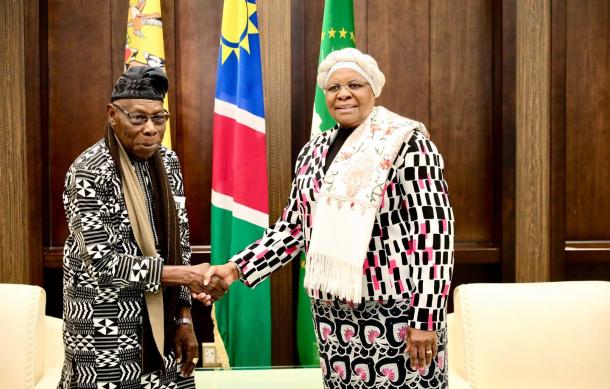
Former Nigerian President Olusegun Obasanjo says Africa must do more to unlock resources within the continent to drive its own investment and economic growth.
Obasanjo, who met President Netumbo Nandi-Ndaitwah at State House, said Africa could mobilise an estimated US$4 trillion from sovereign wealth funds, reserves, contributory pension funds and health funds.
"I think we underrate our own capacity. I think that's the first thing I would say. We underrate our own capacity within Africa. What I understand is about $4 trillion American dollars. That is the money that we can mobilise within Africa from sovereign wealth funds, from reserves, from contributory pension funds, and from health funds. About $4 trillion. How much of that have we within Africa mobilised for our development, our investments?
Despite uncertainty in the global economy, the former Nigerian statesman says Africa remains one of the world's most attractive investment destinations.
Obasanjo cited Namibia as an example of a country offering qualities valued by investors.
"Namibia provides major aspects of that security, stability, and predictability, all that are there. Africa is still the place where you can get the highest return on investment. And if you are in business, you want the highest return on your investment. The only thing that we have to make sure of is that we create a conducive environment for money to come into Africa. Money is out there. Let's create a conducive environment for the money to come and to invest and to stay."
Obasanjo is visiting Namibia nearly three months after attending the country's Independence Day celebrations and briefed President Nandi-Ndaitwah on developments affecting Africa and the broader global landscape.
Nandi-Ndaitwah backed the importance of sustained engagement as African countries navigate global challenges.
"And that's why this constant engagement is very necessary, so that we see how best we can save our people."
The meeting formed part of ongoing efforts to strengthen investment cooperation between Namibia and Nigeria, with bilateral trade standing at just over US$10 million.