


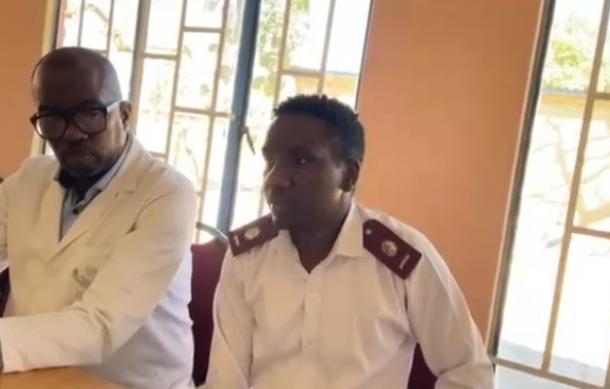
Health officials at the Manghetti Health Centre in the Tsumkwe Constituency say shortages of transport, medical equipment and deteriorating infrastructure are affecting the delivery of healthcare services in the area.
Staff at the Health Centre raised these issues during a visit by a delegation from the Office of the Prime Minister, amongst them the centre's mortuary, which has been out of service for more than a year now.
The facility serves a population of about 6,000 people, many of whom live in remote settlements and depend on ambulance services to access medical care.
Senior registered nurse Mathews Kayambu says reaching patients in distant communities has become a challenge, particularly when ambulances are unavailable.
"The road itself is bad as it is, and our community depends on our ambulance services to pick them up when they fall sick. Someone from Grasshoek will call at 21H00. There are no cars coming this side; if you are hiring a car to bring you to the clinic, it is expensive, and not everybody is employed, and not everybody can afford it. That's why we advise the community that when we don't have an ambulance, they must make use of conservancy one, but they also have their own programmes. The outreach services for us to trace patients who didn't come for follow-up or to see which patients missed their medication are not being conducted because we don't have transport, and when you say you planned for a specific thing, all of a sudden there is an emergency, meaning all the other programmes are on hold."
The health centre's mortuary has also been out of service for more than a year.
According to Kayambu, the facility has only three cabinets, which are insufficient to serve the entire community.
He says delays in obtaining death certificates and other required documentation often result in bodies remaining at the centre for extended periods.
"When it comes to funeral arrangements, it takes time for the community to get all those things in order. Some people don't have papers, and for home affairs to issue a death certificate, they need all those papers, and if there are no documents, the body stays with us for an extended period, and we are also forced to squeeze anybody that comes into those three cabinets."
The centre operates with 30 beds, many of which do not have mattresses.
Kayambu is also calling for the construction of a mini-theatre at the facility, saying patients requiring emergency surgical procedures are often referred to hospitals more than 400 kilometres away.
Poor mobile network coverage remains another challenge, frequently disrupting communication between healthcare workers, patients and ambulance drivers.
According to Kayambu, only three vehicles are currently available to serve all four clinics in the constituency.