


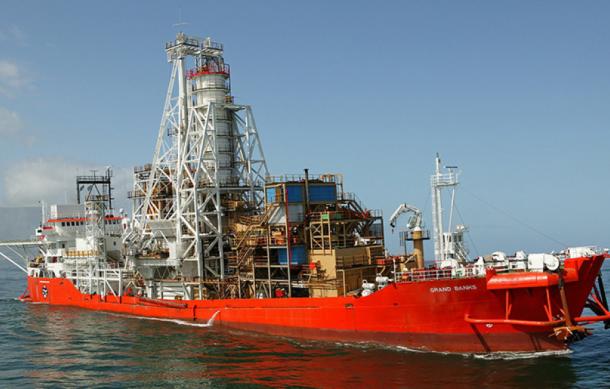
Debmarine Namibia launched a next-generation crawler designed to increase diamond recovery production by 20%.
Two crawlers, valued at N$1.1 billion, were unveiled at the Sturrock Dry Dock in Cape Town, South Africa, earlier this week.
The next-generation crawler is a seabed mining machine that travels across the ocean floor and collects diamonds; it then pumps up these diamonds like a vacuum cleaner onto the recovery vessel, which is the Benguela Gem, for onboard processing.
These machines will deliver a 20% increase in mining rate and a 30% improvement in pump life, redefining operational capability and resilience at sea.
"So to control because it is a remotely controlled subsea vehicle, we have this yellow wire that is connected to the crawler, and that is to control the crawler, and that is how it works," said David Shivute, Project Manager at Debmarine Namibia, adding that, "The new generation crawler is about 370 tonnes, and the old generation is 290 tonnes; that is in excess of 100 tonnes heavier, and in terms of power requirement, it requires about 3.4 megawatts of power to run the trench pump."
The machine is expected to recover around 80,000 natural marine diamonds annually.
Willy Mertens, the CEO of Debmarine Namibia, added that "this 20% production that you see here, and you look at 80 thousand carats because a small vessel produces 80,000 carats, so we say, 'Do we build a new vessel, or do we improve the current one to get 80,000?' So those are the things we look at: improving current technology and getting new technology."
According to Chief Operating Officer Maenge Shipiki-Kali, the crawlers comply with Debmarine Namibia's environmental policies and are environmentally friendly.
"But the exciting thing in terms of our extraction is we don't really dig deep holes, and anything we disturb is 0.5 metres and 9%; we bring it out, we throw it back in, we don't need it, and we don't have any chemicals. It's a safe process."
The next-generation crawler, which was built in-house by Debmarine Namibia and replaces the old-generation Mafuta crawler, is expected to be deployed at sea at the end of September.