


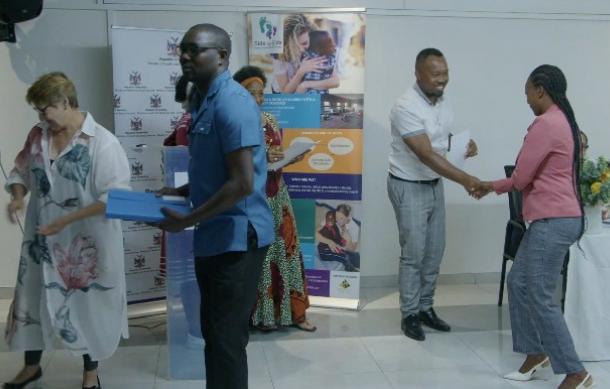
Thirty-two community health workers from the |Khomas Health Directorate were empowered to strengthen their individual contributions to community-based healthcare.
The lay health workers graduated from a training course in screening, identifying and conducting brief interventions for children with disabilities.
The 5-week training programme was implemented by the |Khomas Regional Health Directorate.
It was carried out in partnership with the University of Namibia (UNAM) and Side-by-Side Centre for Early Intervention, with funding from the European Union (EU) and United Nations Children's Fund (UNICEF).
The course combined in-person lectures with practical sessions conducted at the Side-by-Side Centre for Early Intervention.
The programme equipped community health workers with essential skills to identify early signs of developmental delays and disabilities in children.
It also helps the graduates to be able to conduct basic screening and brief interventions.
In addition, the programme will facilitate timely referrals to specialised health and rehabilitation services.
The Acting Regional Health Director for the |Khomas Region, Dr. Kandiwapa Natanael, urged graduates to ensure that no child is left behind in terms of early detection of disabilities.
"This training is a crucial investment in strengthening our community-level capacity in inclusive service delivery. It was offered at no cost to the participants. Graduates, the knowledge you have gained in legal instruments pertaining to children with disabilities, developmental stages and thereby the psychosocial model is not merely theoretical."
Side-by-Side Early Intervention Center Director Huipie van Wyk says the role of the graduates in promoting inclusive and accessible services for children with disabilities is vital.
"Through this programme participants learnt how to apply legal instruments to protect the dignity of children with disability and understand the bio-social model, which reminds us that disability does not just rely on medical but also includes social, emotional and environmental impacts. Identify developmental delays early so that intervention can support our children's future and refer children with disabilities to appropriate healthcare providers, ensuring that no child is left behind."
Speaking on behalf of the graduates, Ndingo Philemon had this to say.
"We must not neglect the people living with disabilities in our communities. So we need to help them and support them in any case in their life."
The other point is that I want us to go with it; we are going in the community, we are from the community, and everyone here is from the community. So just to strengthen our community.