

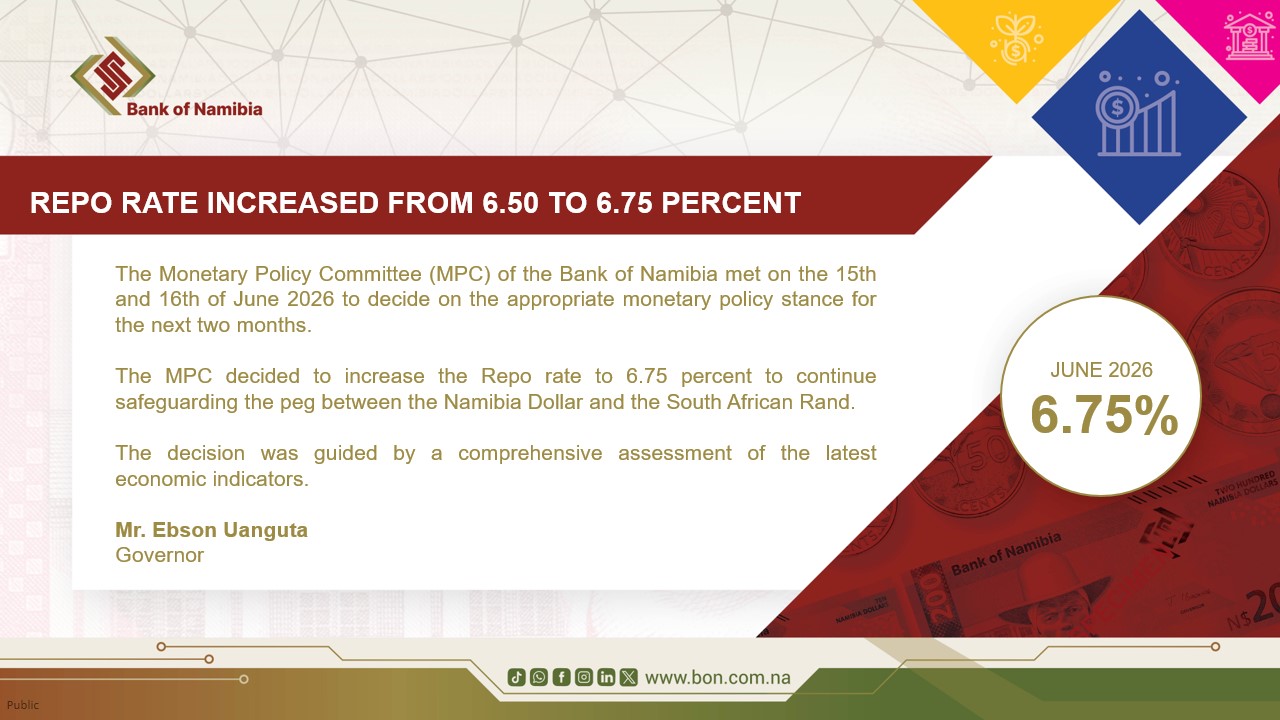
The Bank of Namibia (BoN) has announced a 25-basis point increase in the repo rate to 6.75%. The move came in light of rising inflation, global economic uncertainty, and the need to protect the currency peg between the Namibian dollar and the South African rand.
The decision was announced following the Monetary Policy Committee (MPC) meeting held on 15 and 16 June.
The increase pushes the prime lending rate to 10.25% and will apply for the next two months.
According to the governor, Ebson Uanguta says inflationary pressures have increased both globally and domestically.
Namibia's annual inflation rate rose from 2.1% in March to 4.1% in May 2026, mainly due to higher transport costs linked to rising fuel prices.
"Since the previous MPC meeting, inflation across monitored economies has increased, reflecting the effects of the energy price shock and supply chain disruptions. Notably, inflation rose sharply in South Africa from 3.1% in March of 2026 to 4% in April of 2026. With energy and food prices expected to remain notably higher in 2026, the IMF projects global inflation to increase from 4.1% in 2025 to 4.4% this year before it decelerates to 3.7% in 2027. The stock of international reserves rose from N$51.8 billion at the end of March 2026 to N$55.4 billion at the end of May 2026, mainly due to SACU receipts, customer foreign currency payments and a monetary gold acquisition that we did recently. At this level, foreign reserves translated to an estimated import cover of 3.5 months of imports, which is sufficient to support the currency pack and meet the country's international financial obligations."
Despite signs of improving stability in some parts of the world, global economic conditions remain uncertain.
"The Bank of Namibia will closely monitor the economic data as they are becoming available, particularly developments in inflation expectations as well as capital flows. And we will react appropriately to contain any second-round effects of inflation while safeguarding the currency pack," stressed Uanguta.
Rising energy prices and supply chain disruptions have pushed up inflation in many countries, leading several central banks to tighten monetary policy. The bank noted that Namibia's economy remained weak during the first four months of 2026. Economic activity slowed in sectors such as mining, manufacturing, tourism, construction, and communication.
However, the agriculture sector recorded strong growth supported by good crop production.