


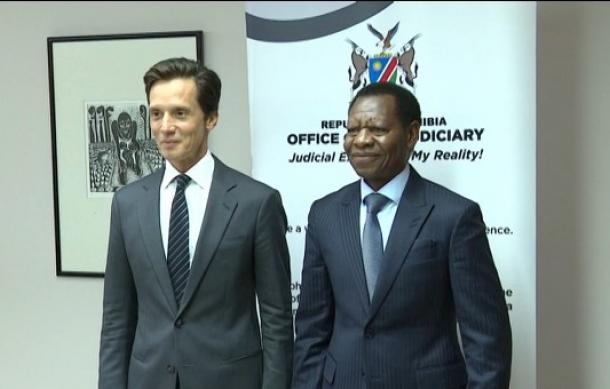
Chief Justice Peter Shivute has outlined the structure and development of the judiciary following constitutional reforms that granted financial and administrative independence to the courts during a courtesy visit by United States Ambassador John Giordano to the Supreme Court.
Shivute said the 2014 constitutional amendment changed the administration of the judiciary, moving it out of the Ministry of Justice and establishing the Office of the Judiciary.
He said the judiciary is now administered separately from the executive branch, with the chief justice heading the institution and an executive director managing day-to-day administration.
Shivute stated that the reforms are intended to separate judicial administration from the executive while maintaining the judiciary's constitutional mandate.
The Chief Justice stressed that Namibia has engaged with international judicial institutions as part of efforts to support judicial training and institutional development.
He referred to exchange programmes and visits involving Namibian judicial officers and foreign counterparts.
“And of course, as you know, we have set up a specialised court called Wildlife Court in Otjiwarongo. And again, I think it's the U.S. foreign department that actually helped us in that regard with some equipment that we're using to record the proceedings there. We are very grateful for that support too.”
Ambassador Giordano said legal practice requires an understanding of the social and cultural environment in which laws operate.
He highlighted that legal reasoning is not only based on statutory texts but also on the context in which laws are applied.
The ambassador said legal research has changed with the use of digital tools but added that engagement with court proceedings and direct observation of legal processes remain part of legal training.
'Law school, they—kids are starting to go online, but I think we said, "Why are we going? Why are we still teaching us to use the law books when you know, on the internet, I can get down on the desk? But certainly, people with the same class barriers. I was very much looking forward to sitting down together, and this was a pleasant surprise."
The Chief Justice said judicial training and international cooperation continue to form part of Namibia's approach to court administration and capacity development. He said these engagements support exchanges of practices between jurisdictions.
The visit formed part of ongoing interaction between Namibia's judiciary and international partners on issues related to court administration, judicial training, and legal education.