


More than 1700 farmers across Namibia were trained in various agricultural and fisheries productions through cooperation between China and Namibia.
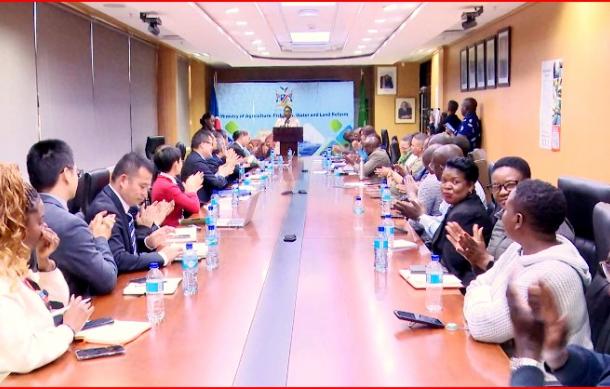
This was revealed at the Chinese agricultural experts' and technicians' welcoming and farewell event hosted by the Ministry of Agriculture, Fisheries, Water, and Land Reform (MAFWLR).
The South-South Cooperation Project Phase Two is a collaborative initiative between Namibia, China, and the Namibian Food and Agriculture Organisation (FAO).
The project is aimed at strengthening Namibia's agricultural and fishery sectors through technical assistance and technology transfer as well as capacity development.
It focuses on several strategic areas, namely plant health, seed production, poultry production, vocational education, training, soil fertility management and fisheries and aquaculture development.
Assistant Country Representative of FAO Namibia, Ferdinard Mwapopi says, "We should all be thinking about the third phase now, and we should all be thinking about the areas for further support so that with FAO facilitation, we can quickly put together some project proposals. The President, Her Excellency Netumbo Nandi-Ndaitwah, identifies agriculture as both a priority and an economic enabler. FAO remains fully committed to supporting Namibia's journey towards a future where every citizen has access to safe, nutritious and affordable food."
Eight Chinese experts were sent in 2024, with four returning to China, while four will remain for an additional three months, complemented by five additional new Chinese experts who recently arrived in Namibia.
The project has achieved significant results in capacity building and technology transfer, leading to strengthened technical capacity of government staff and farmers.
Acting Executive Director at the MAFWLR, Petrus Nangolo adds, " You come to this country to reach out to us, to teach us to share experiences and how to do it. Not only how to do it, but it's actually how to do it much better so that we can remain a competitive nation in the agricultural sector. If it cannot be in southern Africa, it should be in the continent of Africa."
The new experts will be deployed to various regions in the country.