


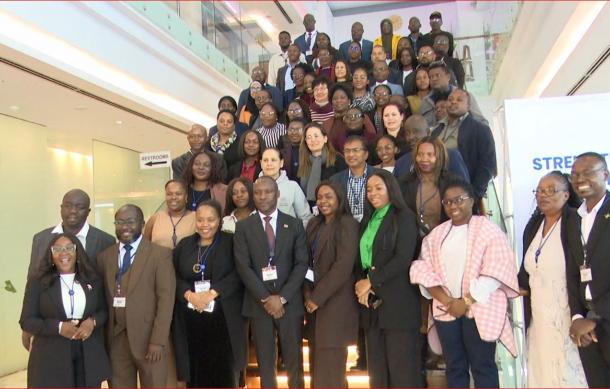
The Ministry of Health and Social Services has called for stronger cross-border cooperation to prevent and respond to infectious disease outbreaks.
Speaking at the Cross-Border and Synchronisation Workshop for Monkeypox and Viral Haemorrhagic Fever Preparedness in Windhoek, the Director of Health Information and Research, Erwin Nakafingo, said movement activities create pathways for the rapid spread of infectious diseases when surveillance and preventive measures are not in place.
Nakafingo stressed that the goal is not only to improve the region's response to viral haemorrhagic fevers but also to build systems capable of responding to future public health emergencies.
He stated that Namibia's position as a regional transport and logistics hub increases the importance of effective monitoring at major points of entry, emphasising that the region also remains vulnerable to diseases such as Ebola, Marburg and yellow fever.
Nakafingo was speaking on behalf of the Ministry of Health and Social Services, Executive Director, Penda Ithindi.
"Diseases do not recognise or rather respect the lines that we have drawn on the map.”
A representative from the International Organization for Migration, Linnah Hangula, says diseases do not respect borders, making information sharing between countries critical.
Dr Hangula stressed that people move across borders for work, trade and other reasons and that infectious diseases can also move with them.
She further emphasised that this makes cooperation between neighbouring countries essential in detecting and responding to health threats.
“A case identified on one side of the border is not a foreign problem. It is a shared signal demanding a shared response.”
The three-day workshop is attended by health officials from Namibia, Angola, Botswana, South Africa, Zambia and Zimbabwe.
The aim is to strengthen surveillance, information sharing and preparedness for viral haemorrhagic fevers and other public health threats.