


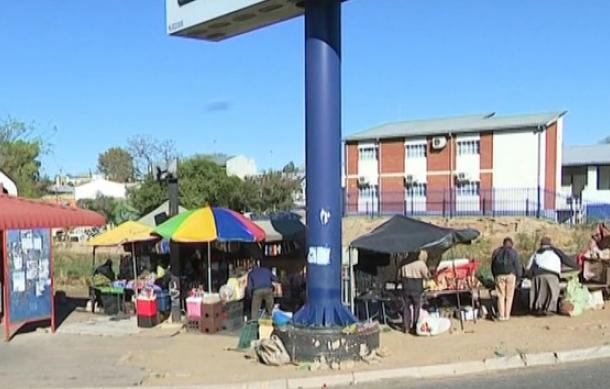
The Windhoek City Police says the enforcement of by-laws on street trade is not meant to prevent people from doing business but to ensure that vending activities are within the confines of the laws.
Under the City of Windhoek's by-laws, vendors are required to operate within approved areas or municipal markets specified in their trading permits.
Trading along roadsides, on sidewalks or in high-traffic areas without official designation is prohibited, mainly due to safety and public access concerns.
Vendors are also required to have valid permits and compliance documents, including fitness certificates, while ensuring access to proper sanitation and ablution facilities.
City Police Deputy Chief, Eliaser Iyambo, explains.
"Our functions are to enforce municipal bylaws. That means if there is any person, whether it's a vendor or any other person who is contravening the law, a police official from the Windoek Municipal Police Service will start the function to enforce the law. When one wants to sell in the streets of Windhoek, if that's the way they should use it, you need to make an application to the CEO, and the CEO should approve. If the CEO declines your application, then you can lodge your appeal to the council for you to be given the permission to trade in the city. And we have what we call informal trading regulations. That's the regulation that's guiding how the application works and what the requirements are for one to trade in the city. And it's a common cause that these traders are only referring to their trading on the road reserves. Is that allowed? Is that the contravention of the law? The answer is definitely yes. It's the contravention of the law. And those are the laws that we are enforcing. We have no specific operation for vendors. We are just carrying out our statutory factions for any transgression of the law, whether it's by crime or traffic-related by-laws."
However, continued enforcement operations by the City Police have raised concerns among street vendors, with some traders being removed from their usual selling points and having their goods confiscated.
"We have been chased for the past two weeks; it started on a Tuesday when they took away our trolleys, and when we asked, 'Where are you taking our products?' they told us they would go through it away. Then we just took some off products, and they went to throw away the trollies, and the next day the same thing happened. We ended up not working at all because it was a long weekend. "We came back Thursday; we suffered the same fate," stated vendor Lazarus Hamukoto.
"And then this morning, I think around 9H00, they came here; again, they passed me, and they told me, 'Yeah, today is the last day to operate. So currently, as I'm standing here, you see, wait, come here. Let's do this. From here to here, it's not the City of Windhoek place from here to here; it's Municipal Place, you understand. So this is the outcome. I'm not by their side. They must leave me alone. I'm actually not a criminal. I'm trying to make a living here. Now currently I'm a refugee in my own country, while I'm just trying to make a living for myself," argued vendor Hildegard Garises.
Street vendors are now calling on the City of Windhoek to assist with designated trading spaces where they can operate legally without the constant risk of displacement.
They say while they understand the need for law enforcement, repeated removals from established selling points are putting their livelihoods and household incomes at risk.
The City Police, however, maintains that enforcement forms part of its mandate to ensure compliance with municipal laws.
"There are a number of platforms. In terms of the Local Authority Act, the council or the town council should hold public meetings once a year. And in the public meeting, that's where we expect people to come and get the accurate and comprehensive information from the council. So that's what we have done. We're also having community meetings. That's a general community meeting where we are sharing the relevant information with community members, of which bylaw is one of them. So they're supposed to understand, they're supposed to attend the meetings and the meetings where we are sharing the information. And it's not like why now? Why not now? One who asked. But the question for determination is, is it a violation of law or not? If it's a violation of law, are there sanctions to be imposed for one who's already in the law? The answer is definitely yes. That's what we are currently doing. There's no specific group of people being targeted by the law enforcement. We are just carrying out our statutory factship as they are prescribed in the statutory laws."
Operations targeting traders operating in undesignated areas may include the issuing of fines or the confiscation of goods where legal requirements are not met.