

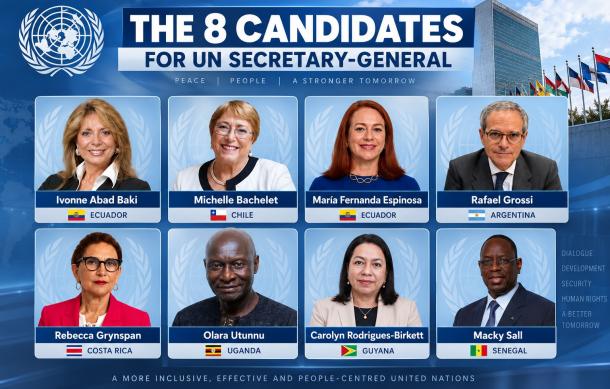
One job. Eight candidates so far. Five countries hold the power to decide who will become the next Secretary-General as the race to lead the UN enters its final phase.
But the next Secretary-General will inherit more than just an organisation in transition, in light of the economic shocks and the onslaught on multilateralism.
So far, eight candidates are now in the race to replace António Guterres in January 2027.
Their vision statements and interactive dialogues are done.
Security Council members also held preliminary straw polls to test the field, and the formal appointment will come from the General Assembly.
But first, the candidate must pass through the Security Council, where the five permanent members hold veto power.
The real contest begins in the Security Council, and for Tuliameni Kalomoh, the former UN Assistant Secretary-General for Political Affairs, the power structure within this body cannot be ignored.
"Now, as to the effectiveness or lack thereof of the Secretary-General, that will depend on the cooperation of members of the Security Council, particularly the permanent five: China, Russia, Britain, France, and the United States."
Kalomoh has seen the organisation's machinery from the inside. He said even the most capable Secretary-General can be constrained when the major powers cannot agree.
"If the two don't cooperate, it doesn't matter how well-meaning, how effective, or how competent the Secretary-General is," he said.
But political analyst Rui Tyitende goes further and questions whether the problem can be fixed by changing the person at the top.
"It doesn't matter who becomes the Secretary-General of the UN. What those global powers decide needs to happen in the world, it will happen with or without the United Nations."
It is a blunt assessment, and he takes the criticism further. "International law, as we speak, is basically the United States foreign policy. What the United States decides will happen tomorrow, it happens whether we like it or not."
The wars in Sudan and Palestine have become stark examples of the gap between diplomatic language and political action.
Guterres himself has acknowledged the problem, saying, "Geopolitical mistrust and suspicion continue to block the effective solutions we need."
But the pressure is not confined to conflict.
The UN system is facing financial strain, including institutions central to addressing global inequalities.
That raises another question for developing countries: whether the next Secretary-General would give the Global South a louder voice or inherit the same imbalance?
Economic analyst Rodney !Hoaeb said the imbalance reaches into the institutions that shape trade and development.
"When we discuss equality, equality also means equality within global organisations. When you have a way that these are not aligned or coherent with the lack of development within the southern parts of the world, then it means that they do not have a proper voice to promote or advance their economic diplomacy."
The leadership contest itself carries another layer as the regional rotation and gender are part of the debate.
The current field includes both women and men. But informal conventions are not rules written into the UN Charter.
And when the final recommendation reaches the Security Council, politics will once again take centre stage.
But the real test of the next UN chief may not be whether one person can lead the world. It may be whether the world body can triumph over differing views and safeguard its founding values.