


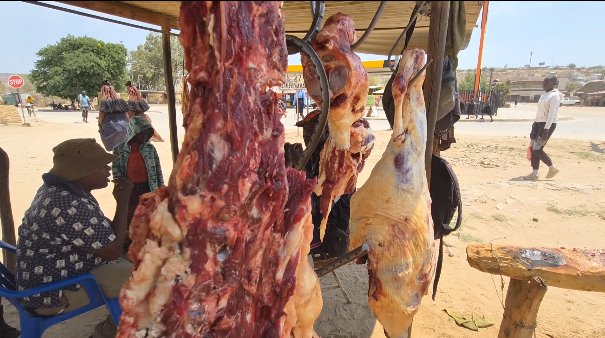
Meat traders at Opuwo are slowly rebuilding after days of losses caused by Foot-and-Mouth Disease (FMD) restrictions that disrupted informal meat sales.
While easing of controls has brought relief, vendors say recovery remains gradual in a trade many rely on for survival.
The restrictions, introduced to contain Foot-and-Mouth Disease (FMD), limited the movement and sale of meat across several regions, including informal trading spaces.
In Opuwo, meat sales remain a key source of income, with some villagers also bringing livestock to town during visits for medical care, school, or shopping to sell as their only source of cash.
Small traders' business was completely brought to a standstill during the restriction period, with empty markets and suspended trade.
Meat Seller Mojaro Tjazimbua stated, "I run a livestock business selling cattle, sheep, goats, and meat to the community. I have been in this trade since 1996. When I heard the news about the restrictions, it affected me severely – my blood pressure went up. This is not the first time we have been restricted, and it always impacts us heavily."
Domingo Kambarandu adds, "This was terrible news, worse than losing a parent. My entire livelihood depends on buying, selling, slaughtering, and reselling cattle and goats, just like the meat you see here. This business is what pays for some of my children to attend UNAM."
Despite hardship, traders say they understood the need for disease control, though some questioned why restrictions were extended outside the outbreak zones.
"Why this affected us is because we heard that FMD was detected somewhere there in Namibia. Now we were thinking, 'Why are we restricted from selling here?' while there is nothing confirmed? They should have just said, 'We should continue selling here but restrict the movement; we are making a living on Kapana selling,' stated Kapana seller Oliver Neumbo.
With the easing of restrictions, vendors report a return of customers; they are hopeful but hesitant.
"We were amazed, amazed very much. If I was wearing an apron, you would have seen it on top of the tree. We danced and said thanks that there was news that we should start to sell again," expressed Fatima Mbwale.
The situation has highlighted how vulnerable informal livestock trade is, as it remains a key livelihood source in Opuwo and surrounding villages.
"The redline should be removed; it serves no purpose. We also want those lucrative markets just like the others, because now the FMD is that side," concluded Kambaradu.