


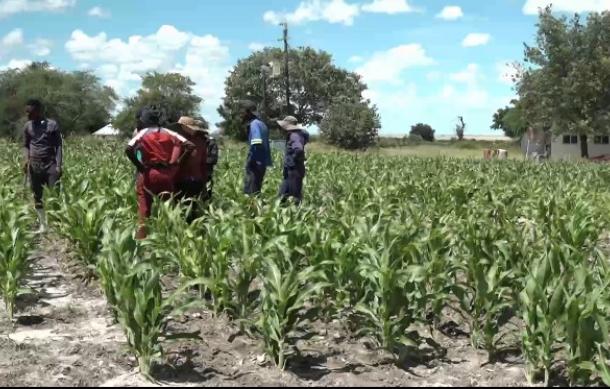
The Okashana Crop Research Station in the Oshikoto Region continues to make significant strides in seed production and multiplication, as well as crop research.
The centre was transferred from the Rössing Foundation to the Ministry of Agriculture in 1990.
Since then, it has evolved into a centre of excellence dedicated to community empowerment, poverty alleviation, improved food security, and job creation.
In an interview with NBC News, Chief Agricultural Technician Alfeus Nghishekwa explained that the station focuses primarily on foundation seeds, including pearl millet, sorghum, and cowpea.
These crops are carefully selected to improve resilience and productivity among farmers.
“These seeds cannot really be planted in November or December because they are short-duration varieties. They take only about 90 days to mature. If you plant them in December, they will be ready by January or February, when it is still raining. Therefore, we advise farmers to plant these seeds a bit later, from around 10 February onwards.”
He highlighted the importance of crop research, seed production, and multiplication in the face of unpredictable weather patterns and advancing technology.
Nghishekwa encouraged subsistence farmers to adopt drought-tolerant and short-duration seed varieties to improve yields and to visit the centre for guidance.
The centre also provides subsidised ploughing and planting services to help boost food production.
“We have a lot of activities taking place here, and we need extra hands to assist us. We therefore advertise temporary positions for community members. These include weeding, bird scaring, and harvesting. We will need about 60 people, and for cowpea screening alone, we will employ around 20 people.”
The station is also involved in mushroom production, and interested community members are encouraged to take advantage of this opportunity to acquire new skills.