


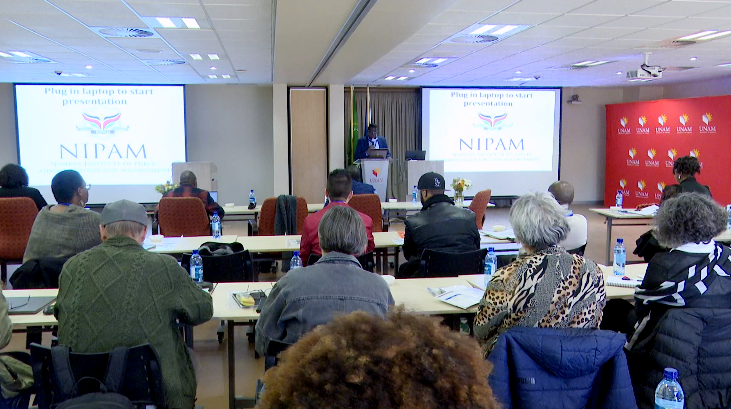
The Minister of Education, Innovation, Youth, Sport, Arts and Culture (MEIYSAC), Sanet Steenkamp, has called for stronger links between research and government decision-making to address Africa's development challenges.
Dr Steenkamp says that Africa must play a leading role in finding solutions to the continent's pressing challenges.
The minister's remarks were delivered by UNAM's Vice Chancellor at the opening of the Second International Geographical Union Commission on African Studies (IGUCAS) conference in Windhoek.
Dr Steenkamp noted that since the first IGUCAS conference was held in Namibia in 2018, issues such as climate change, inequality, migration, poverty and hunger have intensified, requiring urgent and coordinated responses.
"The knowledge is there. The evidence is there. What is sometimes missing is the architecture that connects knowledge producers to decision makers, the trust, the communication, the mutual respect, and the systems that allow scholarship to inform governance."
Professor Kenneth Matengu played a role in the establishment of the International Geographical Union Commission on African Studies.
He stressed that scholars have a responsibility to move beyond academic debate and ensure that research findings inform policies and practical interventions aimed at improving people's lives.
"We are here to bridge the persistent and troubling gap between research outputs and policy implementation, because if knowledge does not move from the academy into the hands of decision makers, knowledge is only half realised. We are here to strengthen the partnerships and the scholarships between African geographers."
South African geographer Maano Ramutsindela has challenged African scholars to critically examine how knowledge about the continent has been produced and represented over the years.
Ramutsindela says researchers must interrogate the relationship between geography and African studies to ensure that African perspectives are central in understanding the continent.
"So what is bad geography in Africa? It's simply the landscape of Africa, which then means that for these authors, these were the landscapes where the slaves could go and hide – the rugged terrains and so forth – and that's the benefit of bad geography."