


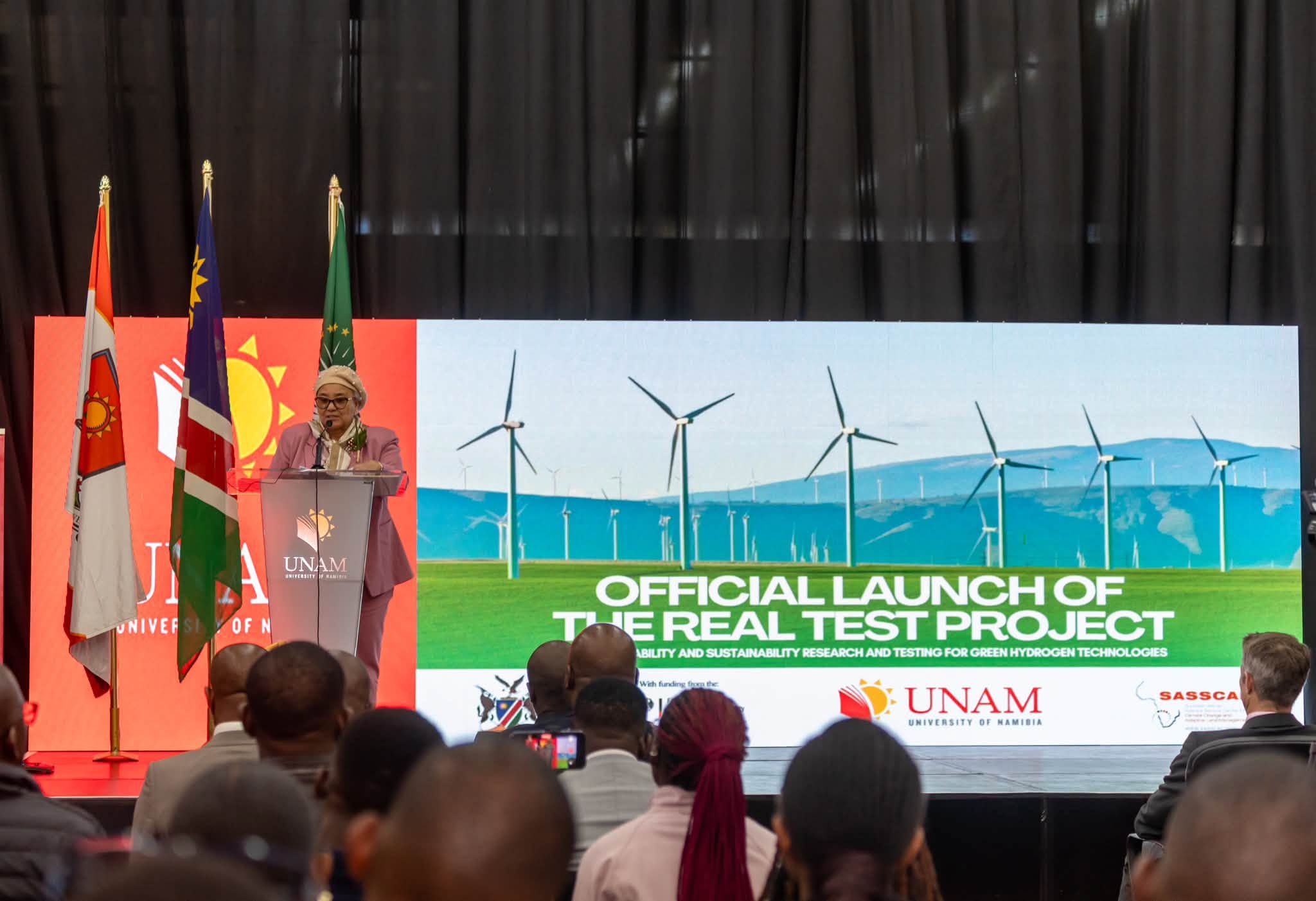
Vice President Lucia Witbooi has officially launched the Real Test Project at the University of Namibia's (UNAM) Main Campus, establishing a new institution for advanced and applied research.
The initiative establishes safe, reliable and sustainable research and testing at the institution, directly responding to the skill shortages and promoting industrialisation, particularly in the national energy sector.
The project is funded with €2,5 million, which is approximately N$54 million. by Germany's Federal Ministry of Research, Technology and Space (BMFTR), facilitated through SASSCAL, under the Namibia-Germany Joint Communiqué of Intent, over the 36-month project duration.
UNAM has also sent ten students to acquire PhDs in research on hydrogen safety, hydrogen material compatibility, failure analysis, storage and transportation.
Witbooi stated that the partnership between Germany and Namibia goes beyond financial and technical cooperation, as it is an investment in knowledge, in people and in the future productive capacity of our country.
"Our ambition is to ensure that Namibians become the scientists; Namibians become the engineers, the innovators, the entrepreneurs and the industrial leaders who will own, shape and drive this transformation. True industrialisation occurs when a country develops its own scientific capabilities, technological expertise, and human capital to innovate, adapt and compete in the global economy."
UNAM's Vice Chancellor, Kenneth Matengu, says Namibia has to develop key competencies in key sectors, emphasising the need for science and education, advanced research and applied research in order to be global competitors in the industrial sector.
"Namibia needs to industrialise, not to be industrialised. I just mean that it should not be somebody else who comes to industrialise us. We must industrialise the country. We should not be looking to the outside world to do it for us. We do it for ourselves. And the only way we can do this is by developing capacity and competencies and strong institutions and systems."
Interim Chargé d'Affaires at the German Embassy, Florian Seitz, stated, "I would like to say that it is very true that the green industries are much more recent and thus currently need to be tested and to be piloted. And probably not all of them will be economically and technologically viable at the end. But that is how progress normally starts and how the future is going to be shaped."