


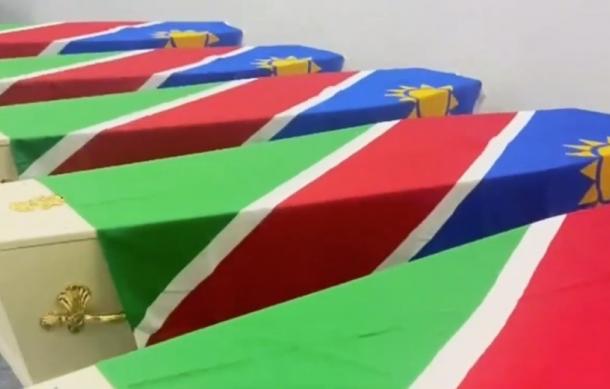
Eighty-four ancestral remains, alongside those of two former Robben Island political prisoners, Festus Nehale and Simon Niilenge, are expected to arrive at the Hosea Kutako International Airport today.
The Minister of Education, Innovation, Youth, Sport, Arts and Culture Sanet Steenkamp at the formal re-humanisation ceremony said the repatriation is about restoring dignity, identity and a connection severed during colonial rule.
At the official re-humanisation ceremony in Cape Town, Dr Steenkamp said Namibia did not come to South Africa simply to receive human remains.
The 84 ancestral remains were removed from their communities during the colonial period and became part of scientific and museum collections.
Dr Steenkamp said they were treated as specimens rather than people with names, families, identities and communities.
"They leave that history behind, but now they return to a free and sovereign Namibia. One can say that they left as a subject, each one of them, of a colonial order. However, with their return to Namibia, they are now citizens of a free and sovereign republic. They do not return as specimens, not as museum holdings, not as forgotten remains. They return as our ancestors, our people, and part of the national story of a free Namibia."
The two former political prisoners, Festus Nehale and Simon Niilenge, were taken from Namibia for resisting colonial oppression and were imprisoned on Robben Island, where they died in captivity.
The minister highlighted that placing the remains in coffins is itself part of the re-humanisation process.
She said death does not remove a person's humanity or the relationship between the deceased, their families, communities and homeland.
Steenkamp emphasised that the repatriation also places responsibility on governments, museums, researchers and heritage practitioners to ensure that the language and practices used to document these histories respect the dignity of the people involved.
South African Minister of Sport, Arts and Culture Gayton McKenzie explained that the sacrifices of the political prisoners and the 84 ancestors who fought for freedom must remain part of the history passed on to future generations.
He said that for 52 years, Festus Nehale and Simon Niilenge remained separated from their families after being arrested and imprisoned on Robben Island.
McKenzie noted that their story is a reminder that freedom in Namibia and South Africa came at a cost.
“They were poisoned. People do not always die immediately when they are poisoned. It was years of torture. Today, Namibia is free, and South Africa is free because of these leaders. I thank God that I could play a role in ensuring that these families were reunited. I have no doubt that the Namibian Government will take it from here, give them a befitting farewell, and involve schoolchildren. Doctor, involve the schoolchildren. As a government, we sometimes tend to forget easily, and we do not create the framework to preserve these memories. To the CEO of Robben Island, I am giving you a public instruction: make sure that the children of the triplets get to visit Robben Island for free.”
The sacrifices of liberation veterans should not be forgotten, he emphasised, particularly by young people who did not experience apartheid and colonial rule.
He added that the South African government and Namibia are committed to restoring dignity to liberation veterans in both countries.
The remains are expected to be taken to Namibia for their final journey home.