


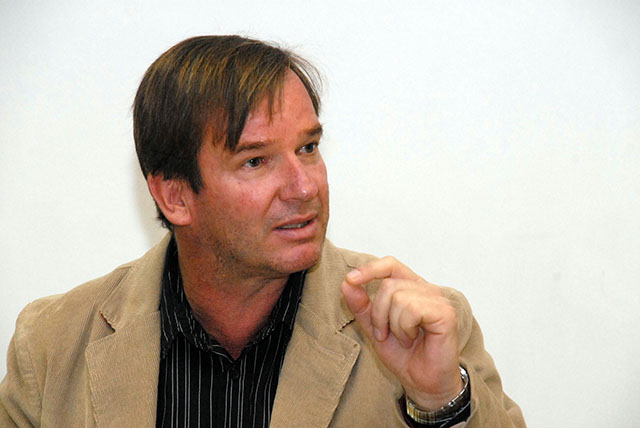
Labour expert Herbert Jauch said that uniformed workers being excluded from the Labour Act is a draconian approach that contradicts the Constitution and Namibia's own Labour Act.
He believes there must be mechanisms for affected members to raise concerns collectively so that justice is done.
Jauch was speaking on NBC's Inside the Chambers programme about a motion that was tabled by Swanu leader Evilastus Kaaronda in the National Assembly surrounding the working conditions of uniformed personnel.
The rights of Namibia's uniformed workers, such as the police, army, and correctional officers, came under the spotlight in parliament last month before the house went into recess.
Jauch said these essential workers have been denied fundamental protections guaranteed by the Labour Act since 1992.
He explained that members of the police, army, and correctional services face poor remuneration, have no way to negotiate for improvements, and work under a top-heavy structure where all power rests with the Inspector General or Commissioner General.
This concentration of power, he said, leads to unfairness even in promotions and disciplinary cases.
"If you want to join a trade union as a member of the police force, you have to ask the Inspector General for permission. That, in effect, makes a mockery of freedom of association."
Jauch said the Labour Act clearly spells out fundamental workers' rights, prohibiting child and forced labour, ensuring freedom of association, the right to join a union and strike, and protection from discrimination and harassment.
But for uniformed services, the only part that applies is protection from sexual harassment.
Basic conditions such as overtime pay, limits on working hours, paid annual leave, sick leave, maternity and compassionate leave, and protection from unfair labour practices do not apply to uniformed personnel.
This, he said, leaves officers vulnerable.
"When Parliament goes into overtime. The MPs get their overtime, but the security personnel outside Parliament, the policemen and women, do not. And that is, of course, a very practical, huge disadvantage that they face."
He said such conditions call for a complete revision of how Namibia treats its uniformed services.
"So decision makers on the government side would argue it's the nature of the work, that we must have them under firm control. There mustn't be disruptions of the services rendered, and therefore, we exclude them. But that's a rather draconian approach."
Another area of concern is grievance procedures, where he said complaints are handled internally and the final decision is taken by the Inspector General.
Jauch argues that this system deprives officers of independent recourse and creates opportunities for victimisation.
"You have a grievance procedure that's open to police or soldiers. But they know if they go through the process, they are likely to be victimised afterwards. They are not going to have their problem resolved. Quite the opposite can happen: they're being victimised because they raised the grievance. And that is, of course, counterproductive."
The labour expert also stressed the need for Namibia to look to international standards.
The International Labour Organisation, he said, recommends that blanket bans on workers' rights be outdated.
According to Jauch, the solution could be to lift the blanket exclusion and instead decide, on a case-by-case basis, which functions are essential and may need restrictions.
This would balance workers' rights on the one hand and national security on the other.