


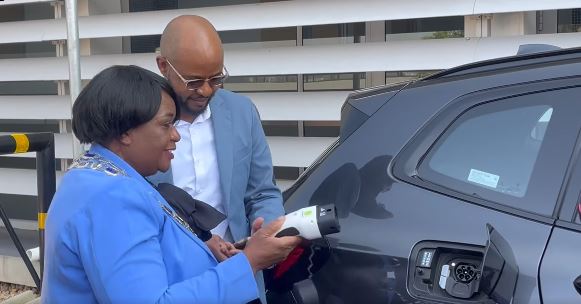
The City of Windhoek has inaugurated its first electric vehicle (EV) charging port at its head office, marking a step toward its zero-emissions goal.
The inaugurated port has an AC slow charger, forming part of the city's broader campaign to raise awareness about climate change, greenhouse gas emissions, air pollution, and the importance of adopting sustainable solutions for a cleaner and healthier future.
Mayor of Windhoek, Ndeshihafela Larandja, described the new charging port as a spark of innovation that will help reduce the city's carbon footprint.
"This is more than a single charging port. It is a spark of innovation that signals a cleaner future for all of us. Transportation accounts for a significant share of global emissions. By enabling electric vehicle infrastructure here, Tesla is helping us reduce our carbon footprint and improve urban air quality. Our investment aligns seamlessly with the council's commitment to climate-resilient development and our long-term goals of a low-carbon transport network. This is only the beginning. Together, we are laying the foundation for a city where sustainable mobility is not an aspiration but a daily reality."
According to Tesla Energy Solutions, charging large vehicles such as BMWs to full capacity will cost as little as N$120, taking about four to five hours with an AC slow charger, while a DC fast charger, to be installed in the near future, should take only 30 to 40 minutes.
Individuals who have electric vehicles can also make use of portable chargers for their homes at a price range of between N$5,000 and N$15,000.
The initiative comes as the City of Windhoek prepares to commemorate Zero Emissions Week 2025, which will run from today to 22 September 2025.
The City of Windhoek EV Charging Port adds to a growing number of these within the capital, others located at locations like the Grove Mall, M&Z Motors and BMW Motors.