


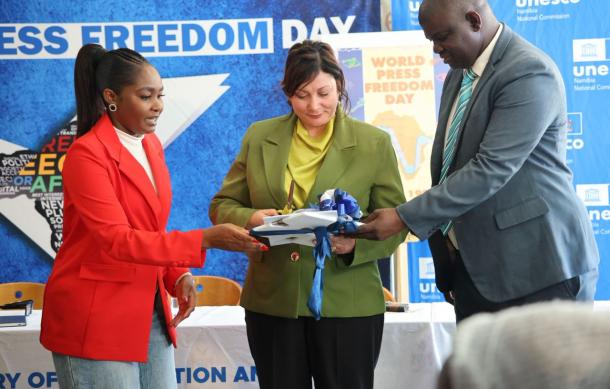
Namibia joined the world in observing World Press Freedom Day, with the official handover of the Windhoek Declaration inscription certificate.
The declaration was adopted in Windhoek 35 years ago and remains an important part of global efforts to promote a free, independent, and responsible press.
The Windhoek Declaration was adopted by African journalists during a UNESCO-sponsored seminar in Windhoek in 1991.
Last year, the Windhoek Declaration was inscribed into UNESCO's International Register of the Memory of the World, recognising its global significance.
Namibia currently ranks 23rd globally and second in Africa on the World Press Freedom Index, reflecting the country's continued commitment to a free and independent media industry.
Speaking during the celebration, the Minister of Education, Innovation, Youth, Sport, Arts and Culture, Sanet Steenkamp paid tribute to journalists for holding those in power accountable.
“Thank you for doing that. With that, you elevate and you capture not just the failures that we sometimes bring forward, but also the hopes and the aspirations and the triumphs of us in our country. And thank you for keeping us in society and government accountable,” she said.
ICT Deputy Minister reaffirmed government's commitment to protecting media freedom and strengthening democratic principles through policy support.
“As government, we remain committed to ensuring that journalists and the media practitioners are able to carry out their work without fear and intimidation. A free media is essential for promoting transparency, accountability, and good governance,” he said.
World Press Freedom Day is observed annually on the 3rd of May following its proclamation by the United Nations General Assembly in 1993.
Veteran journalist Gwen Lister said Namibia must continue leading by example in defending press freedom.
“Among others, we do need to protect journalists from legal and digital harassment and to ensure transparency in government advertising. The delays to the implementation of the Access to Information Act signed into law, as Toivo said, by late President Hage Geingob in 2022 remain problematic. And it is important that government operationalize this as a matter of urgency,” Lister said.
UNESCO Head Eunice Smith said defending press freedom is ultimately about protecting journalists who expose injustice and ensure truth reaches the public, often under difficult circumstances.