


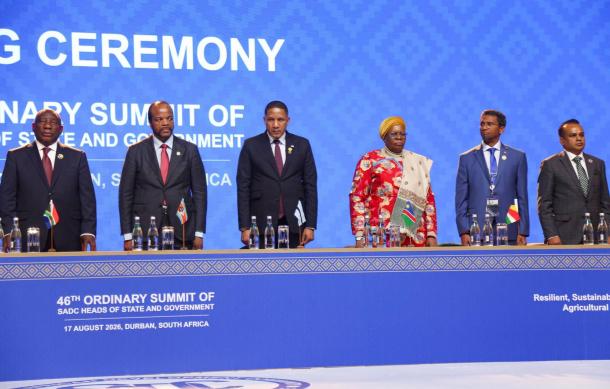
President Netumbo Nandi-Ndaitwah says Namibia aims to leverage its mineral-based economy by strategically managing the mining sector to benefit from the SADC industrialisation programme.
Dr Nandi-Ndaitwah announced this during an interview with NBC News on the just-concluded 46th Heads of State and Government SADC summit that took place in Durban, South Africa.
The Head of State, therefore, noted that building local capacity and training citizens for value addition, such as copper processing, is essential for maximising economic benefits.
"In Namibia, you know that our economy is mineral-based, and we can strategically position ourselves to have our mining sector properly managed so that we'll be able to benefit from the SADC industrialisation programme. Again, when you talk about industrialisation, it's where the issue of value chain comes in. And we have now to strategically position ourselves by training our people to have the necessary skills so that when time comes and say, for example, copper, it is produced in most of our countries. But if we say that we are going to put the initial processing of copper in Namibia, we must have Namibians who are able to do that. If it's the second layer of value additions to copper, we should be able to do that."
Namibia, she says, is further investing in key transport links, including a railway project with Botswana for the Trans-Kalahari Railway, the Orange Corridor and the Kunene Corridors.
These corridors are designed to connect Walvis Bay to countries like Zambia, DRC and South Africa in order to facilitate regional integration.
The President further touched on the peace and security in the region, noting that peace is a fundamental prerequisite for regional development and economic stability.
"So we have really to find a way in order to maintain peace, to bring peace and maintain it in the region. It's very difficult because there are different main problems in this peace process, and another thing that we have to look at, countries where there is prolonged instability in our region is where you have resources. So it is really a question for Africa, a region trying to defend its resources. But there are those who want those resources, and then they have to try their best to see how they can continue to exploit them, maybe in a manner that there is confusion. But we are not going to give up as a region."
Dr. Nandi-Ndaitwah described the summit as successful due to its focus on practical decisions regarding trade and value addition.