


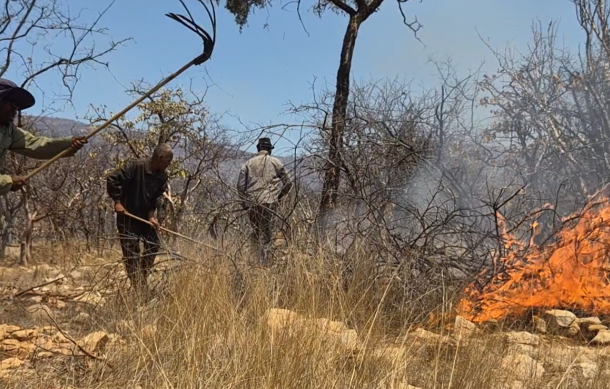
After years of drought, communities in Opuwo Rural Constituency were holding on to the little grass that remained, hoping it would keep their livestock alive through the difficult months ahead.
But now, a wildfire has swept through Otjozongombe Number Two, turning thousands of hectares of grazing land into ashes and leaving livestock owners fearing for their survival.
For communities already weakened by drought, this is more than just a wildfire. It is the destruction of what little hope remained.
The fire, which residents say started on Friday evening, allegedly after lightning struck, has raced through the dry mountains, consuming grazing land relied upon by communities in Otjozongombe, Okanandjira, Otjihorongo, Okombako and surrounding areas.
Mbukamuna Tjombonde, a resident of Otjozongombe, explained, "All these villages from Okanandjira, Okombako, Otjozongombe and the surrounding area have nothing remaining; there is no grass. Grass was here."
For livestock owners, every patch of grass matters.
As seasons have changed, there was already little food for cattle and goats, and residents hoped this would carry their livestock through the next few months. Now, much of it has disappeared in the flames.
The Directorate of Forestry says the fire was reported by the community on Saturday, but they could not attend to it immediately due to lack of diesel and other technical, administrative challenges.
Frans Amunyela, a senior forestry technician, stated, "We are trying by all means to curb the fire, and the thing is, I think we need community members to get involved in this fire because we can't just do it alone. We need community members, probably the police officers or NDF, to come join us here right now. As we speak, we are only 6 from the ministry and one community member. The conservancy people and community forestry are not even here; apparently they are tired because the fire has been burning for two consecutive days."
Amunyela says the region lacks sufficient resources to respond effectively to fires of this magnitude.
The rugged mountain terrain, lack of cutlines and the presence of fleeing wildlife, including elephants, are further complicating efforts to contain the blaze.
Thousands of hectares are estimated to have been burnt, although the full extent of the damage is yet to be assessed.
For a region already struggling with drought, the consequences could be devastating.
The drought took away the rain. The fire has now taken away the grass.
And for families depending on livestock, the question is no longer simply where their animals will graze but whether they will survive.