


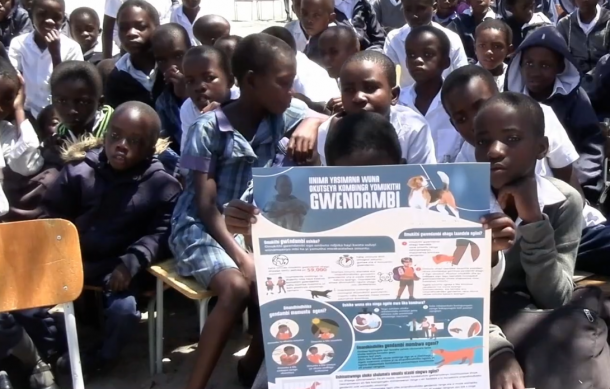
The State Veterinarian for Animal Disease Control in the Oshana Region has called on the Ministry of Education to consider incorporating Rabies education into the school curriculum to help reduce deaths caused by the disease.
Dr. Nelson Herman made the call at Omusimboti Combined School during the belated commemoration of World Rabies Day.
Dr. Herman said Rabies is a deadly disease that continues to pose a serious threat to communities.
Rabies is a viral disease that attacks the nervous system and can be transmitted to humans through the bite or scratch of an infected animal, particularly when saliva comes into contact with broken skin or mucous membranes.
Pet owners are urged to vaccinate their animals annually against Rabies and to keep children away from unfamiliar or stray animals.
Learners were also educated about the signs and symptoms of Rabies and the importance of seeking immediate medical attention after being bitten or scratched by a cat or dog.
Once symptoms develop, Rabies almost always fatal, making prevention and early intervention critical.
"Statistics indicate that about 59,000 people die worldwide every year from rabies, with most deaths occurring in Africa and Asia. This means that, on average, one person dies from rabies every nine minutes. Four out of every ten people who die are children under the age of 15."
Regular vaccination of pets significantly reduces the risk of animals contracting and spreading rabies. Pet owners should also prevent their animals from roaming freely, as contact with stray or unknown animals increases the risk of exposure.
Members of the public are advised not to approach or handle animals displaying unusual behaviour, such as unexplained aggression, excessive salivation, difficulty swallowing, paralysis, or unusual fearlessness.
The State Vet urged anyone bitten or scratched by a suspected rabid animal to immediately wash the wound thoroughly with soap and running water and seek urgent medical attention.
"The effort to fight Rabies is a collective one. Every stakeholder must join forces to safeguard the Namibian child, with the ultimate goal of achieving zero Rabies by 2030.
Members of the public are encouraged to report animals displaying unusual behaviour to veterinary or health authorities.