


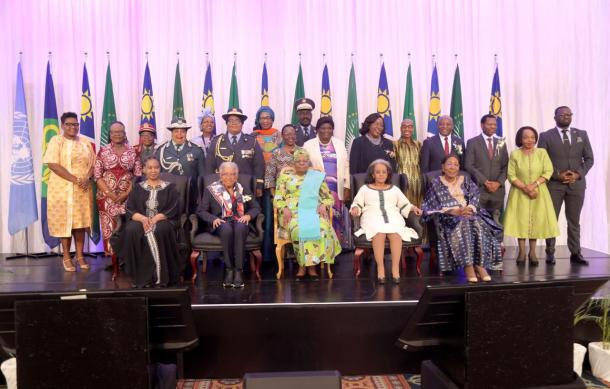
President Netumbo Nandi-Ndaitwah has called for innovative approaches to address persistent gaps holding back the Women, Peace, and Security Agenda.
She made the appeal during the commemoration of the 25th Silver Anniversary of the United Nations Security Council Resolution 1325 on Women, Peace and Security, underway in Windhoek.
Nandi-Ndaitwah noted that the WPS Agenda must evolve to reflect today's global realities.
UN Security Council Resolution 1325 on Women, Peace, and Security was adopted under Namibia's leadership of the council 25 years ago.
President Nandi-Ndaitwah described the adoption as a transformative milestone, pointing out that women's security concerns were once largely confined to the humanitarian sphere.
However, a quarter of a century later, she said women continue to bear the brunt of some of the world's most severe conflicts as global tensions intensify.
"Too often, peace deals, particularly those brokered by external actors in our continent, have excluded women as negotiators and mediators, overlooking their perspectives and lived experiences. This omission has also meant that the specific atrocities endured by women during conflict have not been adequately acknowledged, addressed, or redressed in post-conflict frameworks. Without women at the table, peace is neither complete nor sustainable."
President Nandi-Ndaitwah also cautioned that implementation of the Agenda continues to face challenges in monitoring, evaluation, and coordination.
The Women, Peace and Security Agenda is anchored on four pillars, namely, participation, protection, prevention, and relief and recovery, which are all aimed at empowering women to shape peace and security.
"These pillars remind us that women are not simply victims of war but agents of peace. Resolution 1325 provides a comprehensive framework that links peace and security with gender equality, ensuring that the voices and experiences of half of humanity are never left behind. Importantly, we believe that peace is not only the absence of conflict but the presence of cooperation as well as the respect for human dignity and the mutual care across societies."
The President stressed that women's participation in peace processes does not diminish the contributions of men.
Instead, she said, the roles should complement one another to make peace efforts more effective.
While Namibia and several SADC member states have made strides through national frameworks advancing women's empowerment, resource allocation remains a major concern.
The commemorations brought together former female Heads of State Ellen Johnson Sirleaf of Liberia, Ethiopia's Sahle-Work Zewde, and Catherine Samba-Panza, former President of the Central African Republic, among other leaders.
As countries renew their pledge to Resolution 1325, the message from Windhoek is - peace is stronger when women are included.