


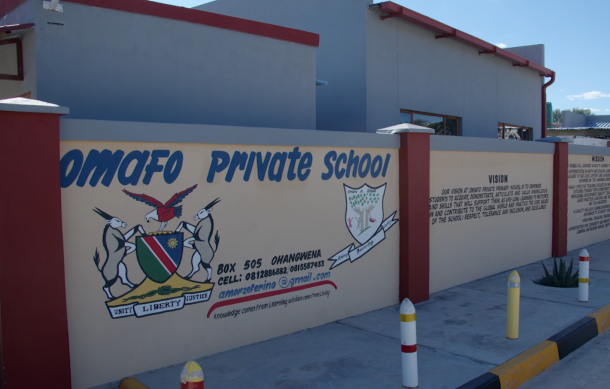
Omafo Private School in the Ohangwena Region has become a beacon of hope for many Angolan children living across the two countries' borders.
The school has gone out of its way to accommodate learners from across the border, who are placed in classes from Early Childhood Development (ECD) to Grade 7.
The school's principal, Grace Shapwa, says out of the school's 378 learners, 68 are Angolan. To accommodate these learners, the school offers Portuguese as a subject to bridge the language barriers and strengthen learning outcomes.
Shapwa highlighted some of the challenges faced by the school, particularly those affecting Angolan learners. Concerns ranged from issues around time, transport and exchange rates.
"If we are starting at seven o'clock, it means it's six. So for them to be able to be on time at school, they have to wake up at five o'clock and cross the border. We have a bus that picks the kids up from the border and brings them to the school. But sometimes because the bus cannot wait for when they reach, because this bus is also not only picking up the Angolan kids, it also has to pick up other learners from Oshikango that are Namibians and that have to be at school on time."
"So the exchange rate is a huge difference. So when we look at how much we are charging, which is a minimum amount, to them it looks huge. Every learner should come in without being boarded at the border because sometimes we have to give them a pass. We have to write letters to say, 'Yes, this child is our student, and please permit them to come through there.' And sometimes they tell them that the date is expired, and it's something that we have to renew for this kid to be able to pass freely from the border."
The school is currently the only school in the Ohangwena region catering for learners with intellectual impairments.
"We deal with kids with Down syndrome. We deal with kids with cerebral palsy. We deal with kids with a lot of disabilities, and we cater to them and we take them inside. So it's a very big success that we are able to just not give education to those who have the ability to do that, those who are doing cognitively, and those who are able to use a pen and paper, but we also look at more than what we are doing now."
Shapwa calls on both countries' governments to come up with an amicable collaboration that will give more learners the opportunity to access education.