


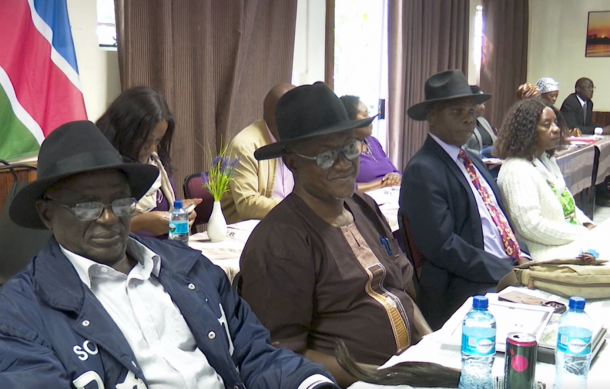
Members of the Chief Council in the Kavango East and Kavango West regions have raised concerns over apparent ineffective coordination between the government and the traditional authorities on land matters.
The chief council members made the remarks during a consultative workshop with the Parliamentary Standing Committee for Urban, Rural Development and Land Reform.
The aim of the engagement was to mitigate challenges faced by the community when accessing land and all other constraints that affect progress within the Traditional Authorities' setups.
They want the law to be amended to ensure transparency, improve land administration systems and provide equal opportunities for all members of society.
The chairperson of the Parliamentary Standing Committee on Urban, Rural Development and Land Reform. Clemencia Coetzee responded, "Most of the challenges are the registration of land problem that they are having, the illegal fencing and the law that is not in place. Most of the complainants are the people that are working with the land issues, sitting on the things and not working on them. I hope and believe that if we go back after this consultative meeting, as a parliamentary committee, we will work on these issues to see how we can help these people that are really suffering on the ground."
Frederich Rugharo, a member of the Hambukushu Traditional Authority, adds, "This consultation comes at a crucial time when communal land governance in Namibia is facing increasing pressure arising from population growth."
Dagobert Mukoya is a member of the Chief's Council.
"Our customary practice does not allow this fencing of land, this registration of land, but then there is another law that tells us to register this land when our custom doesn't speak like that. So that is what we are saying if there is a conflict between customary practices and traditional laws or rights."
The MICT news team also spoke to the Hompa's of the Uukwangali and Gciriku Traditional Authorities, Eugene Kudumo and Haruvita Kayoka.
"For many years now, there have been consultations on land registration, and we have continually rejected it because it's against our culture and tradition. Currently, our people are already selling communal land in the region. Just imagine how the number of sales would increase if it were registered in their names. This will, in turn, lead to many foreigners buying our land, leaving none for our children and livestock."
"When it comes to land registration, if people are refusing, why force them? Things that are forced are not good at all; good things are never forced. If things are being forced, then they are bad. If we register for land whilst we are already suffering, then they are exacerbating the suffering. We have already seen that there will be no progress in land registration."