


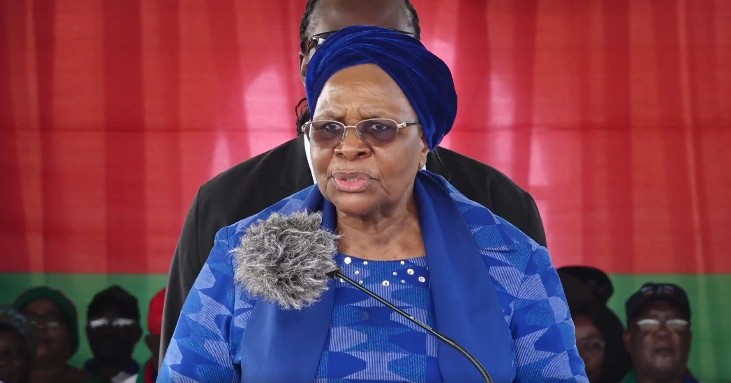
President Netumbo Nandi-Ndaitwah has promised to ensure the decongestion of overpopulated informal settlements through the informal settlement upgrading programme.
President Nandi-Ndaitwah promised this during a meet-and-greet of Swapo Party members and sympathisers along the B1 road in Otavi.
The President, who was on her way from northern Namibia, revealed that towns such as Keetmanshoop, Windhoek, Walvis Bay, Rundu and Oshakati were the first to benefit from the informal settlement upgrades. The aim is to provide land rights, infrastructure, water and sanitation, including affordable housing, to all.
"It's for us to manage informal settlements, because they are really an eyesore; they are not good, and all of us need to cooperate to address these challenges. We have already started in some of our towns. If you read the Swapo election manifesto, we say we want to focus on the towns that are very congested, and when we made our analysis, we found that those are the towns that we must start with, but that does not mean the local authority councils, supported by the officials, cannot make their internal programmes or develop their internal programmes to address the housing problems in our towns."
Dr. Nandi-Ndaitwah called on both regional councils and local authorities to provide land and services, as the programme is meant to benefit needy families.
The President urged Namibians to go out and vote on 26 November in the Regional Councils and Local Authorities Elections scheduled for this month.
"We are now going to complete the two remaining structures: the regional councils and the local authorities. I urge you, fellow Namibians and comrades, to help me by providing individuals who understand the vision outlined in the Swapo election manifesto, which is now part of NDP 6. These individuals will assist me in fulfilling my commitments to the people of Namibia, and they are the ones you want me to hold accountable."
More than 1.5 million Namibians are to vote in 121 constituencies and 59 local authorities at more than 4,800 polling stations.