


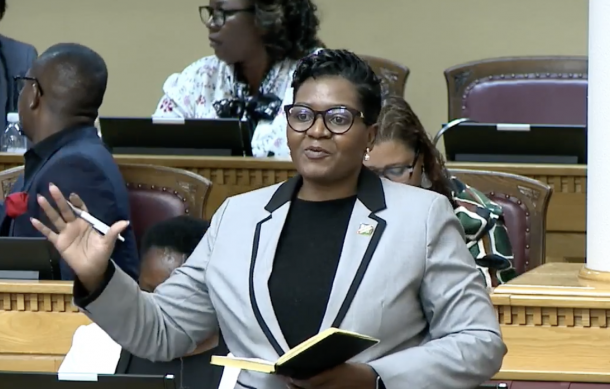
Some Members of Parliament have raised concerns that the needs of the boy child remain under-represented in national programmes.
The concerns were raised during the debate on the Ministry of Gender Equality and Child Welfare's N$417 million budget.
Several MPs criticised the ministry's approach, describing it as largely female-focused, with limited attention given to boys.
Amongst them was In a Hengari of the Popular Democratic Movement.
"I'm a huge proponent of women's upliftment and women's empowerment. But I think we must be very cautious not to do to men what men did to us previously," she said.
Affirmative Repositioning's Tuhafeni Kalola said the number of women trained for business opportunities versus the number of men trained for the same purpose does not align.
"In your motivation, there is roundabout 375 women trained in such kind of things in different sections. But there are only 16 men trained in that aspect," he noted.
Another MP, Willem Hamutenya of the Swapo Party, said men and boys almost do not feature in the programmes of the ministry.
"124 women micro-entrepreneurs were trained under the Start and Improve Your Business model. I don't find myself. 31 women entrepreneurs were trained in digital literacy. I don't find myself. 21 women were supported in agriculture. I don't find myself. So, Honourable Minister, in most of these, I do not see myself. Not anywhere," Amutenya said.
Swapo party MP Tuuliki Abraham noted that to build a safer community and strong families, the emotional well-being of both the girl child and the boy child needs to be supported.
"Supporting boys does not take anything away from supporting girls. It strengthens our entire society," she said.
In response, the line minister, This was the Emma Kantema, said:
"The income-generating activities, where 70% of the generation has been in the argument, we will be conducting activities in this financial year to relocate the operating guidelines. We have seen that with the recent studies, numbers are shifting to 53% there. But also to mention is that when you look at the formal economy, men consist of 51% women less. "
Meanwhile, some MPs questioned whether the budget is sufficient to address key social challenges.
"How is this ministry supposed to stop the increasing cases of gender-based violence with this budget? And then when I look into the budget, there is no funding allocated to the construction of new shelters," IPC MP Lilian Lutuhezi noted.
Armas Amukoto, also of the IPC, was worried about the funds allocated to the prevention of human trafficking.
"Combating of trafficking in patients is allocated 300,000. Is this amount sufficient to fight this cause? With the number of Angolan kids that are tripled and also allegations that these kids are trafficked here."
Rosa Mbinge-Tjeundo of PDM posted questions on the limited number of social workers in the country.
"What is the national vacancy rate for social workers in Namibia? So if we are saying maybe 21 is enough, because it's a very critical position we need to take care of," she said.
Justina Jonas of the Swapo party took issue with the bad labour practices being meted out against workers in some sectors.
"Women in factories, construction farms, mining retail, domestic work, public service, marine engineering and other sectors continue to face wage caps, unsafe and un-conducive conditions of employment, limited maternity protection, harassment, gender injustice and as well as restricted career growth, " Jonas stressed.
AR's Esther Haikola-Sakaria wanted to know if the ministry has effective educational programs in place at the community level to raise awareness about gender-based violence affecting both men and women, particularly in rural areas.
Minister Kantema says the ministry is engaging the Ministry of Works and Transport to secure land for the construction of additional shelters.
In terms of a low number of social workers, the minister says they have received approval from the Public Service Commission to have 134 social workers on their staff establishment.
"We are going to roll this out incrementally. Why? In the market as we stand, we do not have social workers unemployed. Last year, we even went to UNAM. That's how we got the 21. We even went to UNAM and we told them, 'Give us all your graduates.'So, this maybe can be considered as one of the priority areas to encourage our young people to study because we have the positions, but the market is not meeting the demand, " the minister said.