


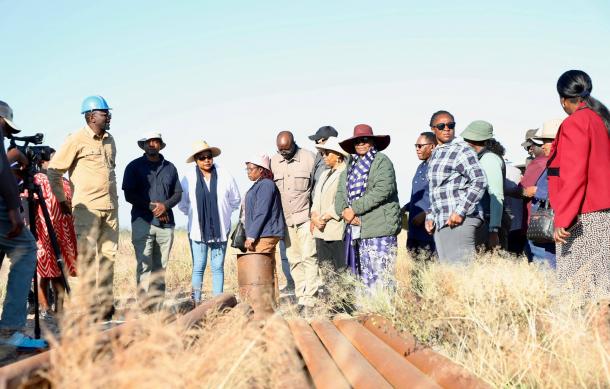
President Netumbo Nandi-Ndaitwah assessed the progress at the Ekoka Brown Field Green scheme project in the Ohangwena Region.
The Ekoka Green scheme project seeks to develop a sustainable, irrigation-based farming initiative focused on maize and vegetable production.
The aim is to enhance food security, creating employment opportunities and fostering skills development for local communities.
The project further strives to transform Ekoka into a hub of sustainable agricultural production in the Ohangwena region.
The initiative is in line with Namibia's Vision 2030 and the Harambee Prosperity Plan II, both of which highlight the importance of agriculture-led rural development and building resilience to climate change.
The project currently employs 200 casual labourers, and President Nandi-Ndaitwah called on them to take the opportunity offered to them seriously.
"You should be proud of yourself for being the project founders; don't be selfish and think only about yourself, but think about the generation to come who are expected to benefit from this project, so work hard and pave the way to enable Namibia to be self-sufficient in food production."
The project is divided into two plots, one on the western and another on the eastern part, where a trial of sorghum, maize, mahangu, and cowpeas was planted this year through rain-feeding.
The planting of cereal crops such as maize and wheat and horticultural crops such as cabbages, potatoes, tomatoes, onions, butternuts, and beetroots is in the pipeline.
"As her excellency has explained, this is a brownfield green scheme just beginning the development; in 4 years from here you will see the real green scheme here, and you are pioneers of the development of this green scheme. Once it is fully developed, hopefully, by the end of this year, this will be the first green scheme in Ohangwena," emphasised MAFWLR Minister Inge Zaamwani.
Three boreholes have already been drilled at the project, awaiting installation.
The fence for the two fields is 80% complete to prevent the animals from destroying the produce.